
Written by Michael VanDerLaan

The driving range is the place where most people get introduced to the game of golf and begin their golf journey. The freedom of being able to hit ball after ball without consequences is a huge advantage when trying to learn the game for the first time. It can also be detrimental to your game if you don’t practice in the right way. In this article we will take a look at the key things you should be doing at the range.
The best way to get better at golf, without lessons is to spend time at the driving range working on your swing.
RELATED: Sunday Golf Loma Bag Review
A Few Tips For Beginners At The Driving Range
1. Warm Up

Golf Gear Advisor staff member Michael VanDerLaan warming up on the driving range.
Always warm up when you get to the driving range.
The best way to warm up is with some light stretching and loosening up without hitting a golf ball or holding a club, but there’s no need to over-do it or disturb anyone around you.
A great way to warm up is to use a training aid like the Orange Whip or a Click Stick. After that, just take some practice swings and feel loose.
RELATED: Lag Shot vs Orange Whip
The other part of warming up is to hit a half dozen balls while NOT working on anything or caring about anything other than feeling the body move and get loose.
Take another 10-15 balls and use them STRICTLY as warm-up shots: swinging easy and just letting the body get in a rhythm before you start trying to work on mechanics or pay attention to the shot quality.
A quality warm up session should always be a part of your practice routine.
2. Use A Proper Grip

The proper golf grip is the most important thing for a beginner to learn, as the old adage says “it is our connection to the club.” There are only a few styles of successful golf grips. The best thing to do is to pick one early on and just commit to it, and trust that it will be more comfortable the more you stick to it.
Two of the best pieces of advice on the grip come from Sam Snead. His father told him, after showing him how to grip the club for the first time, to NEVER change that grip. The other piece of advice is regarding grip pressure. Sam Snead famously said that he gripped the club as if he were holding a baby bird, one of the most oft-repeated pieces of advice in golf lore, as many beginners grip the club too tightly, especially when they get nervous or anxious about a shot.
3. Set Up A Practice Station
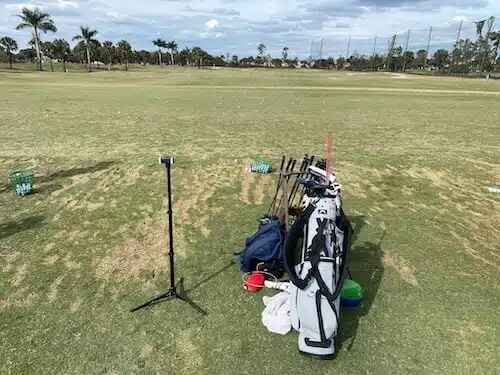
If you go to a PGA Tour event driving range you will often see some degree of a station set up while players are practicing and warming up. A practice station could be as simple as a single alignment stick - or driveway marker - placed on the ground to help aim your club face, set up, or give a visual guide for an in-to-out swing direction.
This will also allow you to see the direction of your divot in relation to your target. Your divot can tell you a lot about your swing.
You can also drive alignment sticks into the ground at an angle matching your club shaft at address, either behind your golf ball or in front of it, slightly offset from the line-of-play in either direction, and practice swinging over or under them to make corrections to your swing plane.
This is super effective, but swing very softly and do half swings until you get really good at this because you can hit one of the sticks and damage your clubs, yourself, or a nearby golfer!
4. Start With Your Shortest Clubs

One of the biggest mistakes a beginner can make is going to the driving range and immediately pulling out their driver, or hitting 1 or 2 balls and then going for the driver. The driver is the hardest club to hit and almost every good player will progress slowly towards hitting it throughout their practice or warm-up routine. After all it is just a bigger version of the same swing used for the other clubs.
One of the most basic driving range tips is to start with a pitching wedge and get a feel for good contact on pitches and half swings, and then slowly work your way up to full swings and the longer clubs as your brain and body get a feel for the low point and release patterns needed for a quality strike.
5. Develop And Use A Pre Shot Routine On Every Shot
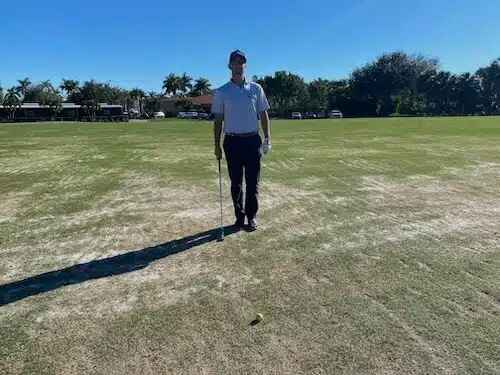
This is one of the most important golf tips you can learn. It’s no surprise that the most famous pre-shot routine in golf history belongs to the most famous golfer in history: Tiger Woods. There are countless videos, articles, and breakdowns of Tiger’s routine and the nuance involved. Many have also timed his routine and seen it to vary less than a half second on most of his shots over the course of a season.
Here is a good video from the PGA of America on Tiger Woods’ pre-shot routine.
The theme here is: organization and consistency. Also remember the adage “practice how you play.” One of the biggest mistakes that amateurs make is going to the driving range and “raking balls” or “banging balls” repeatedly hitting one golf ball after another without moving.
One of the dead giveaways is you will hit an entire bucket of 50-100 balls in 20-30 minutes or less, when it should take 60 minutes or more to hit that many balls. How the best players practice is by stepping away from their stance, mentally resetting, and “walking into” each shot just like they would on the golf course. The pre-shot routine shouldn’t be long - Tiger’s was about 11 seconds in his prime.
6. Always Hit To A Target On The Driving Range
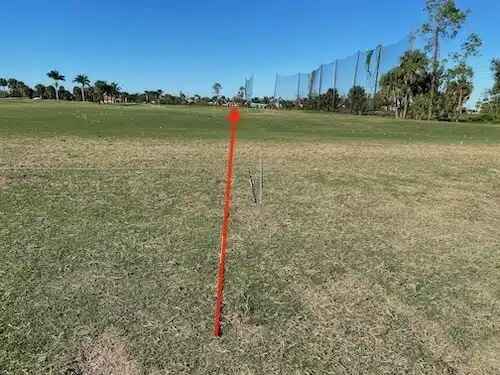
Another place that amateurs get into trouble on the driving range and sabotage their chances of having an effective practice session is that they just aim to a general area instead of a specific target.
Jim Furyk, one of the most accurate ball strikers of all time, has highlighted this as his #1 piece of advice for golfers learning the game. It’s very important to train yourself to always be working towards a target. It also lends a sense of accountability to your practice as you can really see how far off-line your shots are. The old saying “aim small, miss small” should apply even more so in practice than it does on the golf course.
Get in the habot of setting down alignment sticks on your target line and practice hitting to that target.
7. Make Each Shot Count

Along the lines of #5 and #6 the general principle is that most beginners practice very inefficiently and waste a lot of time and a lot of balls by not being organized, level-headed, and objective during their practice time.
After you’re done warming up, make the most out of each ball in the bucket. One great way to do this is to “play games” on the driving range during practice.
Give yourself a goal or a challenge, such as hitting 4 of the next 5 iron shots within a 20-yard window of your flag.
Or pick out two markers and make an imaginary fairway and keep track of how many you can land there with your driver.
You can even give yourself a challenge like “I’m not going home until I hit 6 out of 10 fairways” and simulate a little bit of psychological pressure when you’ve hit 5 out of 9 and are standing over that 10th golf ball!
One of the most important things that can help any golfer maximize their time at the range is to make a practice plan. Check out the example we have above to see what a seriously good practice plan looks like!
8. Use All Of Your Clubs
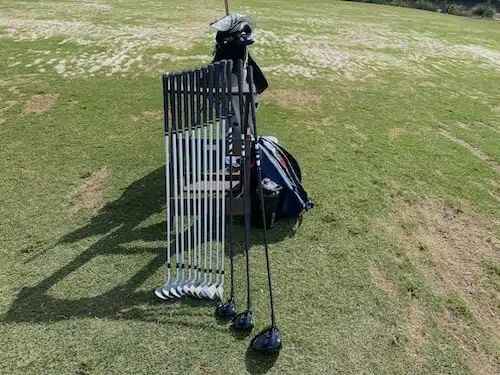
One of the best “rules” in golf is to never try a shot on the golf course that you haven’t confirmed you can pull off in practice. It doesn’t matter if that’s the shot you need for a given situation If you don’t have it, you have to make due with something else.
That said, if you’re going to carry 14 clubs in your bag, you should absolutely learn how to hit all of them. If you have a 3-wood or a driving iron and you don’t use it because you know you can’t hit it - leave it at home! Then you can manage your practice time by working on your weaknesses more often while simply keeping your strengths sharp.