
Written by John VanDerLaan
*We may earn revenue from the products available on this site and participate in affiliate programs.
When it comes to golf footwear engineered for pure performance, the Under Armour Drive Pro golf shoes represent a serious statement from a brand that’s been quietly refining its approach to the game. Built around the proprietary Swing Support System and developed alongside tour players and biomechanics experts, these shoes promise more than just comfort—they promise measurable gains in your swing.
Quick Verdict: Are Under Armour Drive Pro Golf Shoes Worth It?

The Under Armour Drive Pro is one of the most performance-focused golf shoes on the market, and it backs up that claim with real data. Co-developed with Jordan Spieth and world renowned biomechanist JJ Rivet, this shoe was built from the ground up around the Swing Support System (S3), a comprehensive approach to traction, cushioning, and lockdown lacing that aims to optimize your golf swing mechanics.
At the PGA Show Demo Day, testers wearing the UA Drive Pro averaged gains of +11 yards in carry distance, +3.9 mph in clubhead speed, and +4.5 mph in ball speed with driver compared to their current shoes. That’s the kind of quantifiable performance benefit that gets serious golfers paying attention.
Pricing sits at $170 (£150) for the Drive Pro spiked model and $150 (£130) for the Drive Pro SL spikeless version, with both available from February 1, 2024.
What works well:
- Excellent traction through nine spikes positioned for optimal swing support
- Dual foam cushioning delivers outstanding overall comfort over 18 holes
- Lockdown lacing system keeps your foot planted during aggressive swings
- Strong arch and lateral support for golfers who generate high ground forces
- Competitive pricing against other tour-level performance shoes
Where they fall short:
- Synthetic upper feels more performance-tool than luxury
- Styling leans chunky and tour-ready rather than sleek
- May be overkill for casual, dry-climate play
- Very narrow toe box
Design & First Impressions
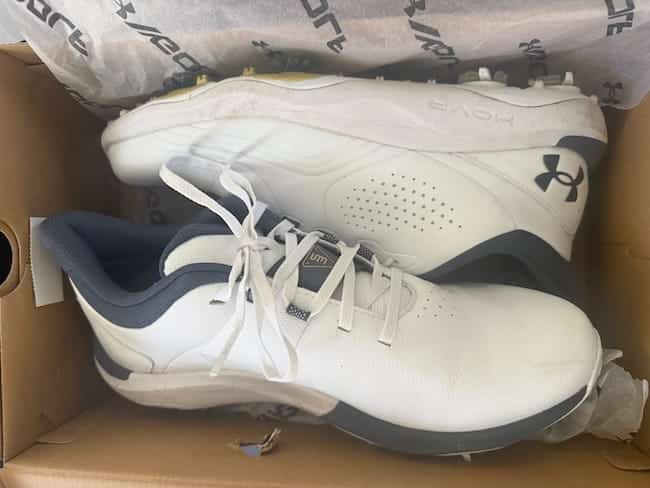
The Drive Pro presents itself as a classic athletic spiked shoe with a slightly chunky, tour-ready silhouette. This isn’t trying to be a lifestyle sneaker you’d wear to brunch—it’s built to perform on the golf course and makes no apologies for prioritizing function over fashion.
The Armour Drive Pro shoes come in several colorways:
- White/Capri/Midnight Navy
- White/White/Metallic Gun Metal
- Mod Grey/Castlerock
- Black/Metallic Gun Metal
The Drive Pro SL spikeless model adds options like White/Metallic Gun Metal and Mod Grey/Capri/Midnight Navy.
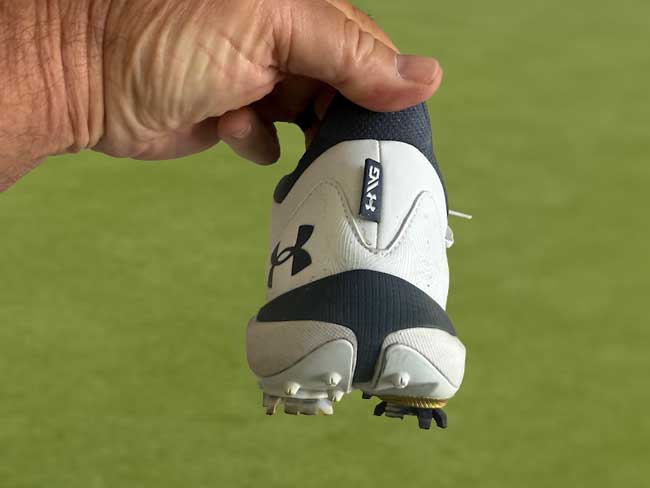
The synthetic upper features textured and perforated zones that balance breathability with weather protection. You’ll find a discreet UA logo near the heel, HOVR branding on the midsole, and S3 branding on the lateral side. The materials feel more performance-oriented than premium-luxury compared to high-end leather models from competitors, but the weight stays just over 12 oz per shoe—light for a fully-loaded performance golf shoe.
First impressions out of the box suggest these new shoes mean business. The construction feels solid without being heavy, and the slightly broader platform hints at the stability focus that defines this golf shoe line.
Fit, Sizing & Comfort
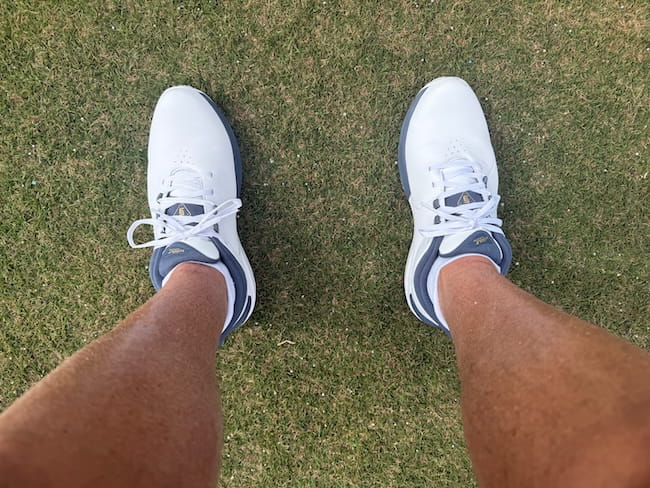
The Drive Pro fits true to size for most golfers with average-width feet. Order your normal golf shoe size and you should be set.
I found the toe box to be very narrow, especially when compared to my Sqairz golf shoes.
For golfers with wide feet, Under Armour offers a dedicated wide fit option. The Under Armour team updated the last (the internal shape) for this generation, making it slightly wider in the forefoot for more toe room and enhanced stability through impact. This change came directly from player feedback on earlier models.
Fit details that matter:
- Padded collar and tongue reduce rubbing over long rounds
- New molded sockliner provides plush, customized feel
- Heel slip is minimal thanks to the lockdown lacing design
- Wide fit option available for broader foot types
- Golfers with narrow feet may find forefoot too narrow
Real-world walking impressions across 7-10 miles on course show reduced foot fatigue compared to typical athletic golf shoes, although my GFore MG4+ golf shoes are more comfortable for walking. The arch support holds consistent throughout 18 holes, which is a major win for golfers who typically struggle with achy feet late in rounds.
Tech Breakdown: Swing Support System (S3)
The tech story behind the Drive Pro centers on the Swing Support System—a three-layer concept spanning upper, midsole, and outsole. This system was created with biomechanist JJ Rivet and tested extensively by Jordan Spieth before hitting the market.
The core philosophy of S3 is about working with your swing’s natural motion rather than fighting it. Instead of simply locking your foot down, the system guides it through loading and transition phases to help you transfer more power into the ball.
The S3 system includes three integrated components:
- Custom S3 spikes: Positioned under key pressure zones to provide smarter traction where you need it most
- Dual-density midsole: Combines softer HOVR foam with supportive Charged Cushioning for energy return and stability
- Swing Support Strap: Integrated with the new lockdown lacing system to keep your foot fully connected to the shoe
This technology package is new for the Drive Pro line and represents the main upgrade from earlier UA golf shoes like older Spieth models. The combination of these elements working together is what sets these Armour golf shoes apart from competitors spending time on just one aspect of performance.
Traction & Outsole Performance
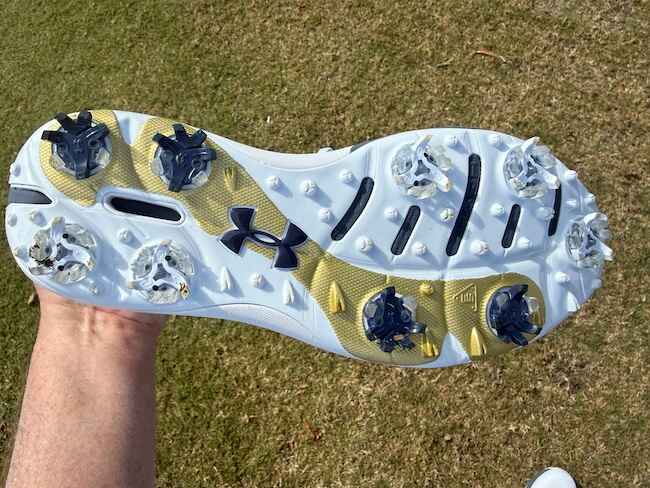
I was very impressed with the traction provided by the Drive Pro shoes. It really feels like my feet are sticking to the ground and I find it easier to use the ground force in my golf swing.
Each Drive Pro shoe uses nine spikes in a carefully mapped configuration. This isn’t random placement—the Under Armour team worked with golf biomechanists to optimize spike positioning for the forces generated during a swing.
Spike layout breakdown:
- Four spikes concentrated around the heel and rearfoot (S3 spikes for rotational resistance)
- Five spikes across the forefoot and toe (Tour Flex Pro spikes for grip through impact)
- Directional S3 spikes oriented to resist unwanted rotation while allowing natural loading
- Tour Flex Pro spikes provide omnidirectional grip during follow-through
The directional traction design is particularly effective in the trail foot during backswing, where the spikes allow proper loading while preventing slippage. This delivers excellent traction across conditions—damp tee boxes, sidehill lies, bunkers, and soft fairways all perform consistently.
Wet and dry testing shows the Drive Pro competing with top models like FootJoy HyperFlex Carbon and Nike Air Zoom Tour Victory 3. Multiple reviewers noted zero slippage across diverse lies and conditions.
For those preferring the Drive Pro SL spikeless model, the hybrid TPU-rubber spikeless outsole delivers penetrating traction that rivals spiked tour shoes. Torsional bars add rigidity that’s often lacking in spikeless shoes, plus you get more off-course versatility. The spikeless golf shoe version suits golfers who want one pair for the course and clubhouse.
Midsole, Cushioning & Underfoot Feel
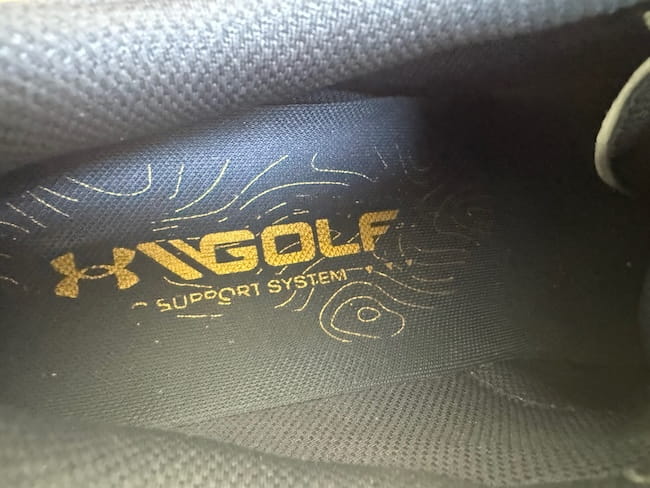
These shoes are super comfortable except for the width in the toes. They really have an athletic feel, as opposed to a comfortable, out for a stroll feel. I feel like I can really go after the golf ball, especially with the driver.
The dual foam cushioning system is what many reviewers call the standout feature of the Pro golf shoes. Under Armour claims this is the only dual density midsole in golf footwear, and spending time in them makes it clear why they’re proud of it.
How the foam placement works:
- Softer HOVR foam concentrated in the medial heel and medial arch (often shown in blue)
- Firmer Charged Cushioning on the lateral forefoot and lateral side (white foam areas)
- HOVR absorbs vertical impact and encourages smooth weight transfer
- Charged foam provides lateral stability during aggressive weight shifts
This placement mirrors your foot’s natural roll during a swing. The medial side sinks slightly to help you load weight, while the lateral side stays supportive as you transfer through impact. The result is feeling low and connected to the ground while still getting noticeable cushioning for 18+ hole rounds.
What you feel on your feet:
- Good ground feedback when posting on the lead side
- Minimal bottoming out when walking 7-10 miles
- Better freshness and less fatigue late in rounds
- Energy return that keeps legs feeling light
I rank this among the best performing golf shoes for cushioning, especially for golfers who walk regularly. The supportive Charged Cushioning prevents that “dead” feeling you get in some heavily cushioned shoes while the softer HOVR foam keeps fatigue at bay.
Support, Stability & Lockdown Lacing
The lockdown lacing system anchors from the lateral ball of the foot across to the medial instep, using an integrated elastic band—the Swing Support Strap. This design pulls your foot down and into the shoe rather than just tightening across the top.
The result is reduced internal slide during aggressive swings and quick transitions. Your foot stays planted where you put it, which translates directly to more power transferred through the ball rather than lost to slippage inside the shoe.
Stability performance across conditions:
- Heel hold remains solid even on damp mornings
- Midfoot lockdown eliminates the sliding that costs you yards
- Lateral stability holds up on uneven lies and sidehill stances
- Arch support stays consistent over full rounds
- Wider base provides planted feel during heavy loading
Golfers who typically struggle with arch fatigue or plantar discomfort should find the ultimate stability and support here. The slightly broader last gives a planted feel during loading phases, particularly beneficial for players who swing hard or generate high ground reaction forces. This lockdown is what helps deliver more power through impact.
Weight, Durability & Weather Protection

At just over 12 oz (approximately 340g) per shoe in a men’s US 9, the Drive Pro is impressively light for a fully spiked, tech-heavy golf shoe. This keeps leg fatigue manageable even when walking 18 holes on hilly courses.
The synthetic upper shows solid durability after repeated rounds. Expect minor cosmetic creasing but no major structural breakdown. The materials maintain their shape and support over time.
Durability and weather notes:
- One year waterproof warranty covers typical rain and morning dew conditions
- Upper handles wet rounds without soaking through
- Spike system holds up well with minimal wear after multiple 18-hole walks
- Base plates show no significant degradation through heavy use
- Easy to clean with basic scrub brush after muddy rounds
For golfers in wetter climates, the waterproofing proves reliable for typical round conditions. The golf equipment performs as expected through a full season of regular play, making the cost-per-round calculation favorable for frequent players wearing these regularly.
On-Course Performance: Distance, Consistency & Feel
The performance benefits of the Drive Pro aren’t just marketing claims—they’re backed by third-party testing. At the PGA Show Demo Day, golfers switching into Drive Pro from their own shoes saw average gains of approximately 11 yards in carry, 3.9 mph in clubhead speed, and 4.5 mph in ball speed.
These gains come from better traction and improved weight transfer tightening shot dispersion, particularly with driver and long irons. When your foot isn’t slipping, more of your swing energy goes into the ball.
What you feel during swings:
- More secure footing when posting up on the lead leg
- Easier to push off the trail side during transition
- Less slipping on wet tee boxes and damp conditions
- Greater confidence to commit fully to aggressive swings
High-swing-speed players and those who generate significant ground force will likely notice the biggest benefit. That said, mid-handicappers who walk the course regularly can still feel more stable and confident, which often translates to better ball striking even without measurable speed gains.
Th