Titleist T100 Irons Review: Specs, Performance & Who They’re For

Written by John VanDerLaan 

*We may earn revenue from the products available on this site and participate in affiliate programs.
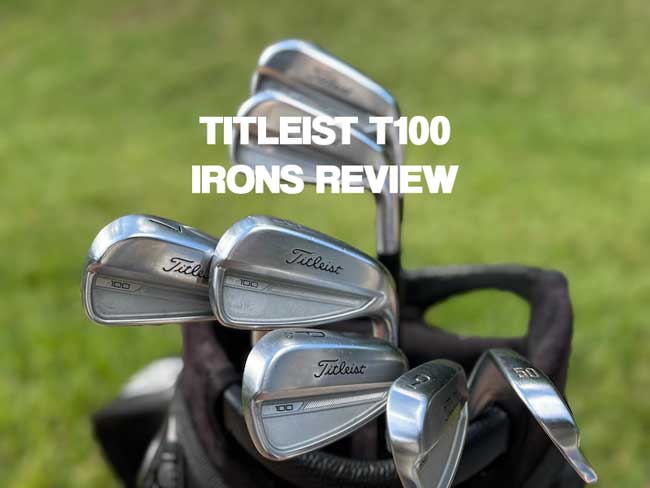
Titleist T100 Irons Review Featured Image

The Titleist T100 irons have landed, and they’re making a strong case as the modern tour iron for accomplished players who want precision instruments rather than distance machines. After extensive testing both on launch monitors and across multiple rounds, it’s clear these clubs deliver exactly what Titleist promises: elite control, predictable spin, and the kind of feedback that helps a skilled golfer shape shots with intention.

This review breaks down everything you need to know about the T100 head, from specs and pricing to real-world performance data. Whether you’re considering these as your new irons or weighing them against other T Series options, you’ll find the information you need to make the right call.

Quick Summary: Are Titleist T100 Irons Right For You?

Pros:

  • Elite control and precision for approach shots
  • Superb solid feel and detailed feedback
  • Tighter dispersion through multi-material construction
  • High spin rates (5,500–6,000 rpm with 7-iron) for stopping power
  • Improved turf interaction across varied conditions
  • Capable shot-shaping for creative players

Cons:

  • Limited forgiveness for mid and high handicaps on significant mishits
  • Premium pricing 
  • Compact size may appear intimidating to developing players

The Titleist T100 sits at the precision end of the current T Series irons lineup, which includes the T100, T150, T200, and T300 models arranged by increasing forgiveness and distance focus. These clubs are explicitly designed for low-handicap players and strong ball-strikers who prioritize control, consistent yardages, and the ability to flight the golf ball rather than chasing raw distance.

What Titleist calls the modern tour iron retains classical tour iron characteristics—compact profile, thin top line, minimal offset—while incorporating contemporary engineering like tungsten weighting and variable face thickness. The result is a club that one reviewer described as “the iron my heart wanted, made playable.” You get the feedback and shot-shaping capability that accomplished players demand, with meaningful improvements in consistency across the face.

This review focuses on the 2025 T100 head from 3–PW and how it integrates into blended set configurations with T150 or T200 for longer irons. If you’re a 0–7 handicap player who values precision and feedback, you should actively seek a fitting for T100. Golfers with handicaps of 13 or higher, or those with inconsistent strike patterns, should explore the more forgiving T250 or T300 options instead.

First Impressions & Looks at Address

Titleist T100 Iron

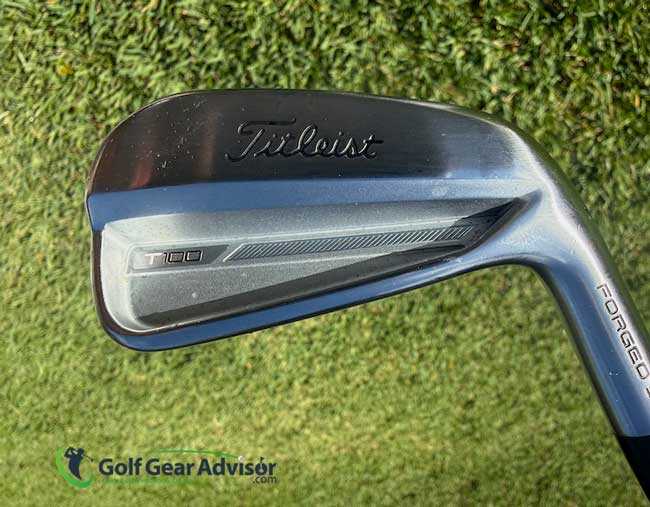
Unboxing the T100 reveals a head that feels immediately familiar to anyone who appreciates Titleist irons. The brushed chrome finish with subtle gun-metal accents gives the club a refined, professional appearance. Updated cavity backing and the classic Titleist script are cleaner and less busy than competing tour irons, creating a visually uncluttered look that appeals to serious players.

The T100 retains its compact tour profile. The top line is definitively thin—noticeably thinner than the T150 or T200 models in the same lineup—and offset is minimal. The blade length runs relatively short compared with other T Series irons, reinforcing the players irons classification that defines this club.

Thin Top Line And Minimal Offset On The Titleist T100 Iron

Visual changes from the earlier T100 are evolutionary rather than revolutionary. You’ll notice a slightly cleaner cavity, softened toe shape, and more muted cavity engraving. The overall look maintains the traditional T Series aesthetic that accomplished players expect, with refinements that reduce visual distractions rather than introducing dramatic changes.

Behind the golf ball with a 7-iron at address, the club frames everything cleanly. The top line appears to disappear behind the ball rather than dominating your visual field. The back edge of the cavity stays largely concealed from the player’s perspective, creating an impression of simplicity and control. Better players will appreciate this “no distractions” aesthetic, though some mid-handicappers may find the head intimidatingly compact.

Face And Grooves On The Titleist T100 Iron

Key look and feel takeaways:

  • Classic, compact players iron silhouette
  • Thin top line with minimal offset
  • Refined cavity design with muted engraving
  • Clean address position that inspires confidence
  • Traditional Titleist aesthetic maintained

Titleist T100 Irons: Models, Specs & Pricing

Closeup Of The Titleist T100 Irons

The T100 sits at the tour control end of the Titleist T Series family. Within this structure, T100 offers the most compact head and most traditional loft specifications, T150 provides a moderate step toward forgiveness with slightly stronger lofts while maintaining a players profile, T250 introduces more game-improvement geometry, and T350 delivers maximum forgiveness and distance focus for higher handicaps.

Stock Set Configurations:

  • Standard 7-piece set: 4–PW
  • 3-iron available as custom order
  • Gap wedge (50–52 degrees) available through custom ordering
  • Full custom fitting options through Titleist partners worldwide

Loft Specifications (2025 T100):

Club

Loft

3-iron

~21°

4-iron

~23–24°

5-iron

~27°

6-iron

~30°

7-iron

~34°

8-iron

~38°

9-iron

~42°

PW

~46°

These lofts are one degree stronger than the previous T100 iron, so players upgrading from 2023 may see marginal yardage differences. However, the emphasis remains on traditional players iron specifications rather than the jacked lofts found in distance-oriented game improvement irons.

Stock Shaft Options:

  • True Temper AMT Red or AMT Tour White steel (S300/X100 flex)
  • Tour-validated graphite shaft options available for custom fittings (Project X, Accra, and other tour-preferred brands)
  • Standard grip: Titleist Universal 360 grip (with full custom upgrades available)

Pricing Guide: A stock 7-piece set (4–PW) of T100 irons typically retails around £1,250–£1,450 / $1,400–$1,600 depending on shaft configuration and region. This positions the T100 at the premium end of the tour iron market, reflecting the multi-material construction and tour validation.

Distance, Launch & Spin Performance

Author Testing Titleist T100 Irons On The Trackman Launch Monitor

Author Testing Titleist T100 Irons On The Trackman Launch Monitor

My testing of the T100 irons combined indoor launch monitor sessions with more than 30 full 18-hole rounds, over 3 months, using a Titleist Pro V1X golf ball. 

For the 7-iron with a club head speed around 90–92 mph, carry distance averaged in the low-to-mid 170-yard range. Testing notes reference variance between 168 and 174 yards, indicating tight consistency in carry distance across multiple center-face strikes. Ball speed remained remarkably similar across the face compared to the T150, confirming the focus on control rather than maximum total distance.

Launch characteristics reflect the design intent for approach shot precision. The T100 produces a mid-high launch with peak heights exceeding 100 feet (approximately 30+ meters). Descent angle falls in the high 40-degree range—steeper than distance-oriented irons and aligned with what tour players prefer for holding firm greens. This steep ball flight produces minimal roll-out, essential for tournament play and demanding course conditions.

Backspin performance with the 7-iron reaches approximately 5,500–6,000 rpm for center-of-face strikes. These numbers support the “hit and stop” philosophy that accomplished players need when attacking pins. The more aggressive groove design in the short irons (8–PW) helps retain more spin in light rough and wet conditions, addressing a common need for confidence when hitting from imperfect lies.

The long irons (3–5) show improved launch compared to previous generations thanks to the new muscle channel design. This technology lowers center of gravity and promotes higher peak heights with better carry distance consistency—addressing the historical challenge of gapping long irons properly. Expect a bit faster launch and improved stopping power on those demanding approaches.

Distance and spin takeaways:

  • Consistent carry distance rather than maximum distance
  • Controlled spin rates supporting precision approach play
  • Mid-high launch with steep descent angle
  • Traditional lofts prioritizing predictable gaps
  • Long irons benefit from improved launch through muscle channel

Forgiveness, Playability & Shot-Shaping

I tested the T100 irons with 80 gram KBS Players Graphite Iron Shafts and Winn Dri-Tac grips.

KBS Players Graphite Iron Shaft

Although the T100 is visually and tactilely a players cavity back iron, Titleist has engineered meaningful forgiveness into the club head through multi-material construction and strategic tungsten weighting. This represents a key balance: delivering the feedback and shot-shaping capability accomplished players demand while protecting against the worst consequences of small mishits.

Forgiveness in practical terms means that small toe or heel strikes lose approximately half a club of distance but maintain start line and curvature trajectory. You won’t see the big hooks, blocks, or unpredictable ball flights that pure blade designs produce on off-center contact. The Split High-Density Tungsten placement in the heel and toe areas is specifically designed to keep ball speed elevated on mishits, translating to tighter dispersion and more predictable distances.

Variable face thickness in the 3–7 irons maintains speed and launch consistency across the face, particularly protecting the long irons where off-center strikes are more common. One reviewer noted surprise at “how much tungsten Titleist’s engineers packed into the heel and toe to make this club more stable on mishits.”

Turf interaction receives attention through a variable bounce sole and pre-worn leading edge. The club glides through firm and soft turf without digging, valuable for golfers with steeper swing planes who historically struggle with excessive turf interaction. Testing confirmed good-not-great strikes still reached the green, and bad swings left reasonable up-and-down chances rather than disaster.

For playability and shot-shaping, the T100 delivers exactly what a more skilled golfer expects. You can easily flight the ball high or low using loft adjustments and swing modifications. Working small fades and draws is natural and intuitive—the head responds clearly to swing intent instead of straightening everything out through excessive forgiveness technology.

The limit is important to define: bigger misses still get punished. Mid and high handicap golfers wanting “point and shoot” forgiveness will be measurably better served by T200 or T300 models.

Best fit for T100 forgiveness profile:

  • Single-digit handicaps
  • Solid ball-strikers with consistent contact
  • Competitive amateurs seeking control over maximum forgiveness
  • Players who can find the center of the face most of the time

Feel, Sound & Feedback

Testing The Titleist T100 Irons Against Titleist 620 CB Irons

The fully forged construction of the T100 delivers what reviewers consistently describe as “soft and crisp”—occupying the ideal middle ground between soft (potentially mushy) and crisp (potentially thin or firm). The center-of-face strike produces a dense, substantial sensation that communicates quality construction and solid contact without harsh vibration.

Sound is notably muted and mid-tone. Think approximately 90% quiet “thud” with 10% brightness—neither the loud metallic ring of hollow-body irons nor the silent, dull sound of some soft-forged designs. Indoor versus outdoor sound may vary, with controlled hitting bay environments potentially amplifying the sound more than on-course conditions.

Feedback is highly detailed, allowing accomplished players to easily distinguish between center, toe, heel, and thin strikes through both sensation and sound. This detailed response is valuable for players who use shot feedback as a learning tool to refine their strike. However, mishits are clearly communicated rather than masked by technology—appealing to the target demographic but potentially feeling harsh to less accomplished players.

Compared to previous T100 or T100S generations, the 2025 model feels marginally more solid and stable on moderate mishits due to refined weighting and face design. The turf interaction contributes meaningfully to overall feel, with the variable bounce sole and pre-worn leading edge creating a smooth, gliding sensation through grass.

Feel and sound highlights:

  • Tour-preferred “soft and crisp” sensation from forged construction
  • Muted mid-tone thud without hollow-body click
  • Detailed feedback for strike location differentiation
  • Smooth turf interaction enhancing overall feel
  • Minimal harsh vibration even on off-center contact

Technology Inside the T100

Although the T100 presents a traditional, compact silhouette at address, the head incorporates substantial engineering optimized for consistency and control. The real story is how Titleist has hidden modern technology inside a classic package.

Multi-material forged construction: The primary body and face are forged from steel, combined with strategically positioned high-density tungsten in the heel and toe areas. This architecture fine-tunes center of gravity positioning while concentrating mass where it matters for stability.

Split High-Density Tungsten weighting: Distributed in heel and toe areas, particularly emphasized in the 3–5 irons where long iron forgiveness matters most. This positioning keeps ball speed elevated on off-center contact, translating directly to tighter dispersion. The amount of tungsten incorporated surprised even experienced fitters.

Variable Face Thickness (VFT) in 3–7 irons: This technology modulates face thickness across the striking surface to maintain consistent ball speed despite variations in strike location. The result is lower CG performance with protected distance on slight mishits.

Muscle channel in 3 and 4 irons: A new channel structure in the cavity of the longest clubs lowers center of gravity by repositioning mass, increasing both launch angle and peak height. This addresses the historical challenge of long iron performance.

Progressive groove design: Different groove designs across the set recognize that different clubs serve different purposes. Long irons feature standard groove patterns optimized for launch, while scoring irons (8–PW) incorporate more aggressive, narrower grooves designed to boost spin in rough or wet conditions.

All design elements are heavily tour-validated, with PGA Tour players actively testing and adopting the 2025 T100 heads. The technology preserves classic feel while making performance more stable across the face.

Who Should Play the Titleist T100 Irons?

Titleist T100 Irons In My Titleist Staff Bag

The target golfer for the T100 is explicitly defined: tour professionals, elite amateurs, and low-handicap golfers who consistently find the center of the face and want precision approach play over maximum forgiveness.

Handicap and swing profile guidelines:

Category

Handicap Range

Recommendation

Best fit

0–7 handicap

Consistent contact, moderate to high club head speed, preference for control

Usable but demanding

8–12 handicap

Strong ball-strikers willing to sacrifice forgiveness for control

Not recommended

13+ handicap

Better served by T200 or T300 for help on mishits

The T100 integrates effectively into combo sets. Many players pair T100 from 6–PW with T150 in the 4–5 iron range or T200 in the 3–5 iron range, creating graduated forgiveness that maintains control where it matters most (scoring clubs) while adding stability in long irons. This blended set approach requires proper fitting to ensure smooth gapping between different models. Titleist fitters can adjust lofts—whether you need two degrees flat or other specifications—to dial everything in.

Course types where T100 excels:

  • Firm, fast greens requiring stopping power
  • Windy conditions where you flight the ball down
  • Tournament setups demanding precise yardage control
  • Links or heathland courses with firm turf

Professional fitting with loft, lie, and shaft optimization is essential to unlock full performance, especially for golfers in the 8–12 handicap range. The 2025 fitting system with new hosel and head weight adjustment capabilities makes custom fitting more precise than previous set configurations.

Titleist T100 vs Previous Generations & Other T-Series Models

2025 T100 vs. 2023 T100: The 2025 model maintains the same overall DNA but incorporates subtle changes. The primary practical difference is one degree stronger lofts throughout the set, producing marginal yardage gains for players upgrading. The new muscle channel in 3 and 4 irons, refined variable face thickness, and more aggressive grooves in scoring irons represent incremental engineering refinements. For golfers happy with their current 2023 T100 gapping and ball flight, upgrade benefits are modest. Those seeking better long iron launch, tighter dispersion, or improved rough performance may find the investment worthwhile.

This is evolution rather than revolution—don’t expect dramatic differences unless you’re coming from significantly older other irons.

T-Series Model Comparisons:

Model

Best For

Key Differences from T100

T100

0–7 handicaps, tour control

Most traditional lofts, smallest head, maximum control

T150

5–12 handicaps wanting balance

Slightly stronger lofts, more ball speed, bit more forgiveness, slightly thicker top line

T200

10–18 handicaps seeking help

Significantly stronger lofts, game-improvement geometry, more distance focus

T300

15+ handicaps, maximum forgiveness

Full game-improvement with maximum offset, thickest sole, distance-first design

The T100 maintains its status as the tour benchmark in the Titleist range, along with the 620 CB irons. It’s not trying to compete with distance-oriented irons from brands like Cobra DS Adapt, and the Ping G440 or other competitors that employ aggressive loft strengthening. Titleist’s philosophy is that accomplished players choose these irons for consistent control and feedback, not maximum distance or beginner-level forgiveness. Great review feedback from tour players confirms this positioning.

Final Verdict: Should You Buy the Titleist T100 Irons?

The Titleist T100 irons represent excellent execution of a tour control iron that balances modern stability with classical feel, feedback, and shot-shaping capability. Testing confirmed elite control and consistency, a classic look at address, tour-preferred solid feel, and meaningful forgiveness for a compact head without visual or tactile compromise. If you’re looking for precision instruments for your short game and approach shots rather than distance machines, these deliver.

The key buying criteria center on valuing precision, predictable spin, and intentional ball flight over raw distance and built-in forgiveness. If you want to know exactly how a club responds to your swing input, appreciate detailed feedback, and shape shots with intention, the T100 fits your game. If you’re seeking maximum distance or more forgiving “point and shoot” performance, the T250 or T350 are more appropriate choices.

It’s an excellent choice for first-time T Series buyers or those with significantly older irons who will notice substantial improvements in feel, consistency, and modern forgiveness technology. As an upgrade from the 2023 T100, benefits are more marginal unless fitting data shows clear improvements in dispersion or long iron launch. I’d strongly encourage anyone in that situation to test both generations before making a decision.

If you’re a low-handicap golfer chasing tour-level control and feedback, the Titleist T100 remains one of the most complete players irons you can put in the bag.

Photo of author

John VanDerLaan

John is the Lead Editor and founder at Golf Gear Advisor. He is a golf coach and mentor to his 2 sons that are current playing professionals. His son John is currently playing on the PGA Tour and his son Michael is currently playing on mini tours and preparing for Q School. John Sr. has been their coach and mentor since they were 2 years old. He helped them to succeed in golf with the right equipment, instruction and mindset. John knows a thing or two about playing good golf and he has a passion for sharing his knowledge with others.

Leave a Comment