
Written by John VanDerLaan
*We may earn revenue from the products available on this site and participate in affiliate programs.
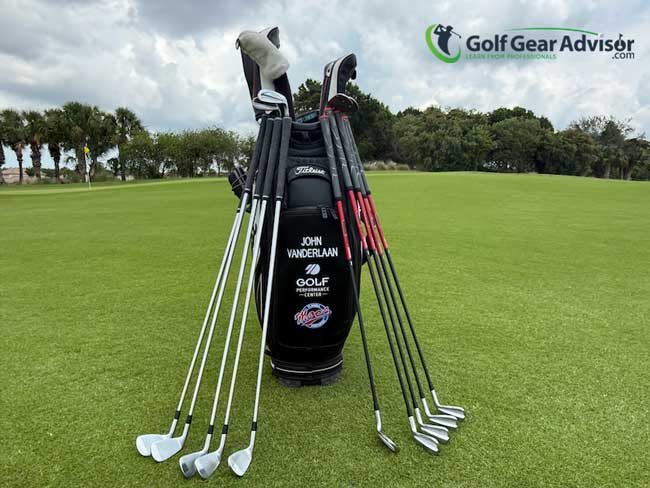
Titleist 620 CB And T100 Irons On The Driving Range
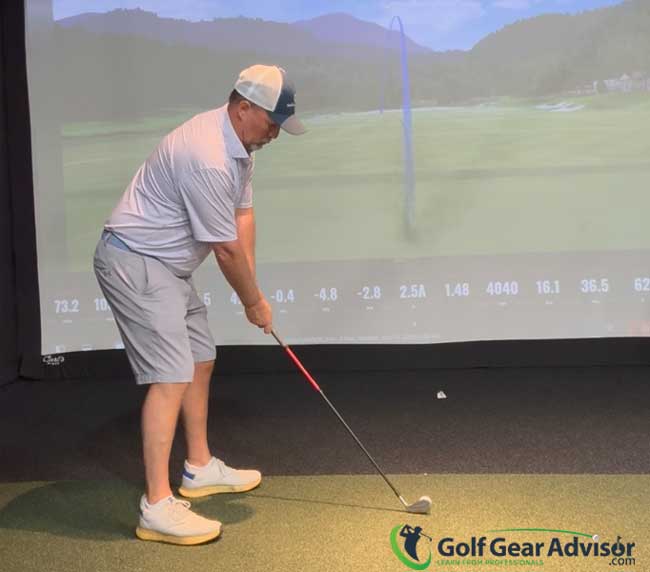
We have tested a lot of irons over the years, and we definitely have our favorites. I play the Titleist T100s, while my sons, John and Michael play the 620 CBs. We got together on the driving range to compare the two irons and determine the differences.
Here's what we found.
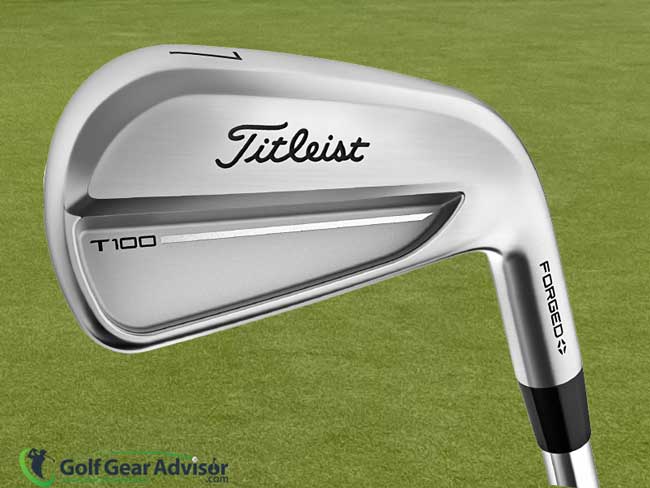
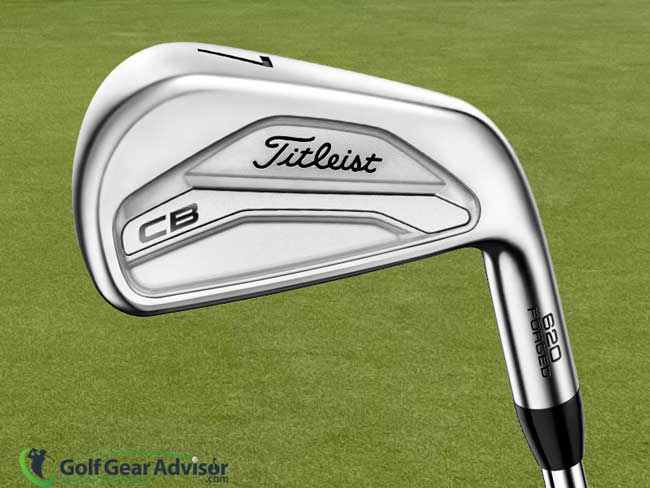
Summary: The Titleist CB delivers a purer forged feel with traditional aesthetics, while the T100 provides measurably more forgiveness and approximately half a club more distance. Both irons have great turf interaction. Your choice depends on whether you prioritize classic feedback or modern performance benefits.
Both Titleist irons target skilled ball-strikers, but they approach the game from different design philosophies. Below is a detailed breakdown of how these clubs compare across every performance category.
Titleist T100 vs 620 CB: Key Differences
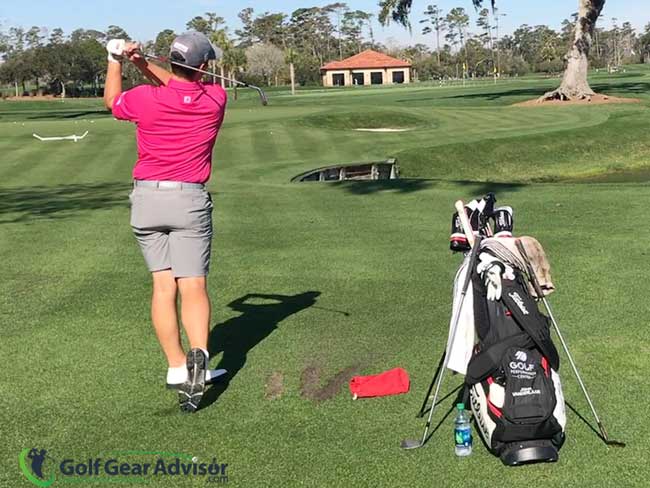
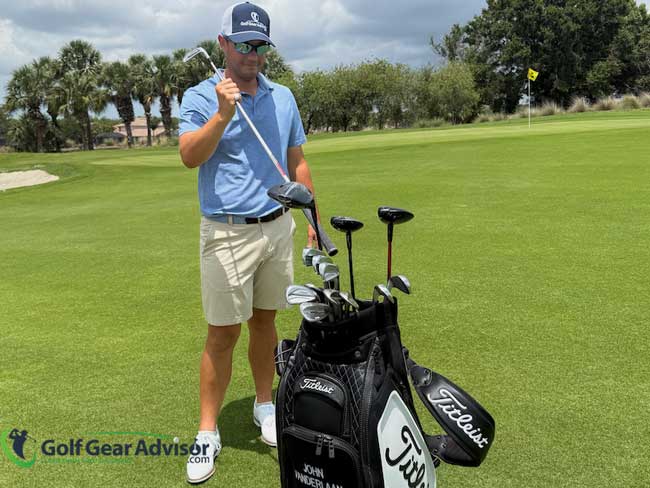
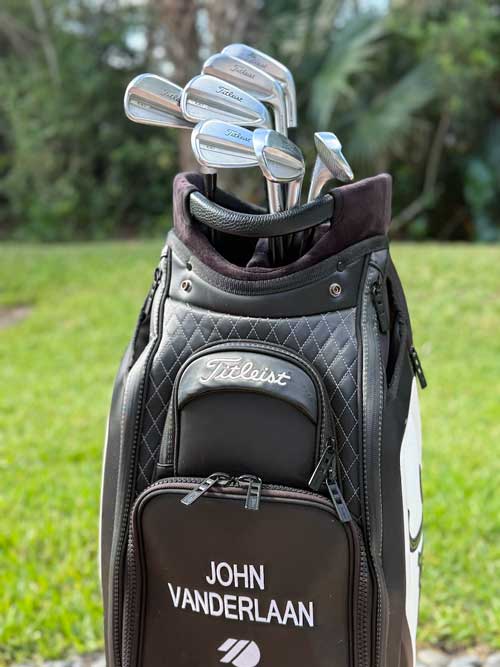
PGA Tour Player John VanDerLaan Comparing Titleist T100 and CB Irons On The Back Of The Range At TPC Sawgrass
The core difference between these irons comes down to construction philosophy and technology integration.
- The CB series uses one-piece 1025 carbon steel forging for maximum feel, with co-forged tungsten only in the 3- and 4-irons
- The T100 employs multi-piece construction with tungsten weighting throughout(3-7) plus advanced face inserts
- Target players differ slightly: the CB suits purists who want traditional feedback, while the T100 appeals to better players seeking a bit more forgiveness without sacrificing control
In testing, the T100 has shown to retain more ball speed on mishits and produce approximately half a club more carry compared to the CB under similar conditions. The 620 CB, honestly, provides clearer feedback on strike quality but punishes off-center hits more severely.
Design and Construction
The physical design of each iron set reflects its performance philosophy and target player.
Titleist 620 CB Design

The CB embraces a classic look with compact, blade-like profiles that many players on the PGA Tour have favored for years. Key design elements include:
- One-piece forged 1025 carbon steel construction throughout mid and shorter irons
- Co-forged high-density tungsten in heel and toe of 3- and 4-irons for improved MOI
- Progressive blade lengths with thinner top line in short irons
- Refined sole camber for improved turf interaction
- Offset ranging from approximately 3.1mm in the 3-iron down to 1.5-1.6mm in the pitching wedge
The head profile at address presents a thin top line with minimal visual bulk—a look that better players prefer. Sole geometry has been updated from previous CB models to provide smoother turf engagement without adding mass.
Titleist T100 Design
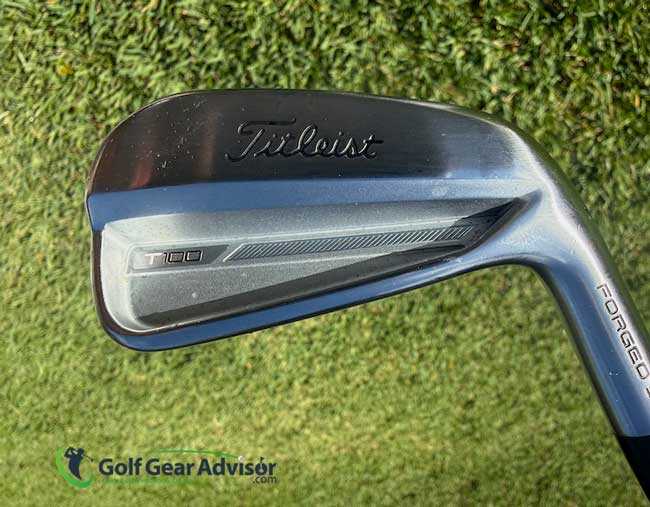
The T100 takes a different approach, hiding significant technology beneath a similarly compact exterior:
- Multi-piece forged construction with SUP10 face inserts in certain irons
- High-density tungsten weighting positioned in heel and toe across 3-7 irons
- Updated sole bounce geometry with variable bounce placement (toe vs heel)
- Continuous face design for more consistent leading edge performance
- Offset similar to CB: approximately 3.4mm in 3-iron tapering to 1.3-1.4mm in wedges
The T100 maintains the thin top line and compact profile that makes it visually compatible with the 620 CB for players considering a combo set or blended set approach.
Distance and Ball Speed Performance
Distance differences between these irons stem from both loft specifications and technology integration.
620 CB Distance Performance
The CB uses more traditional lofts that run slightly weaker than the T100:
- 3-iron: 21° | 4-iron: 24° | 5-iron: 27° | 6-iron: 31° | 7-iron: 35° | PW: 47°
- Smash factor measured at approximately 1.37 in 6-iron testing
- Spin rates around 4800 rpm in mid-iron testing
In comparing the 620 CB to the T100 at the same 31° 6-iron loft, the CB carried within about 3 yards of the T100. However, players switching to T100 commonly report gaining roughly half a club more distance due to improved launch conditions.
The CB requires more swing speed and strike consistency to maximize distance, particularly with long irons where ball speed can drop more significantly on mishits.
T100 Distance Performance
The T100’s stronger lofts and tungsten weighting create measurable distance advantages:
- 3-iron: ~20° | 4-iron: ~23° | 5-iron: ~26° | 6-iron: ~29° | 7-iron: ~33° | PW: ~45°
- Enhanced ball speed retention on off-center strikes
- Optimized launch conditions through CG positioning
The difference in lofts means comparing clubs by number can be misleading. When loft-matched, the T100 still edges ahead due to better energy transfer from its multi-piece construction and perimeter weighting. For players who hit their long irons inconsistently, the T100 provides noticeably better results in terms of carry distance.
Feel and Feedback

Feel remains one of the most personal aspects of club selection, and these irons deliver distinctly different experiences.
620 CB Feel Characteristics
The one-piece carbon steel forging in the CB serie produces what many players describe as a pure forged feel:
- Soft, responsive sensation at impact with pronounced feedback
- Off-center strikes produce more noticeable vibration
- Muted, classic “thwak” sound that tour players have preferred for years
- High feedback quality makes it easier to evaluate strike location
This feedback serves a purpose—skilled players use it to diagnose their swing and make adjustments. However, the amplified sensation on mishits can feel harsh for some players. The CB essentially tells you exactly what happened at impact, for better or worse.
T100 Feel Characteristics
The T100’s multi-piece construction creates a different feel profile:
- Slightly firmer overall sensation due to face insert technology
- More consistent feedback across the club set
- Somewhat dampened response on off-center hits
- Brighter sound profile on mishits, satisfying contact on pure strikes
Many players note that the T100 feels more stable through impact. The technology integration moderates extreme feedback, which some interpret as less pure feel while others appreciate the consistency. The trade-off between feedback intensity and shot consistency becomes a personal preference.
Forgiveness and Playability
This category reveals the most significant practical difference between these iron sets.
620 CB Forgiveness
Despite tungsten in the long irons, the CB offers limited forgiveness compared to the T100:
- Lower MOI in mid and shorter irons means greater distance loss on mishits
- Sole width and camber assist turf interaction but don’t compensate for strike errors
- High workability allows skilled players to shape shots (fades, draws) more readily
- Best suited for players with consistent strike patterns
The 620 CB rewards precision. Players with handicaps of 5 or below who hit the center consistently will appreciate the control and feedback. Those who miss the sweet spot regularly may find the forgiveness gap tough to overcome.
T100 Forgiveness
The T100 provides measurably more forgiving performance:
- Higher MOI from tungsten placement retains more ball speed on mishits
- Tighter dispersion patterns under identical swing conditions
- Better launch recovery on heel and toe strikes
- Balances forgiveness with shot control capability
Players upgrading from older cavity back designs often find the T100 offers the best blend of control and mishit performance. The stability improvements make it playable for mid-handicaps (6-12) who want a players’ iron without the blade-like punishment of the CB.
Technology and Innovation
The engineering differences explain much of the performance gap between these irons.
620 CB Technology

The 620 CB represents refined traditional construction:
- One-piece 1025 carbon steel forging for uniform metallurgy
- Co-forged tungsten in 3- and 4-irons only
- Progressive shaping matched with 620 MB profiles for blended set compatibility
- Refined sole camber updated from previous generation
- Manufacturing precision focused on feel consistency
Titleist positioned the 620 CB as a modern interpretation of classic iron design—incorporating just enough tech to improve long iron performance while preserving the characteristics that low-handicap players have preferred for decades.
T100 Technology
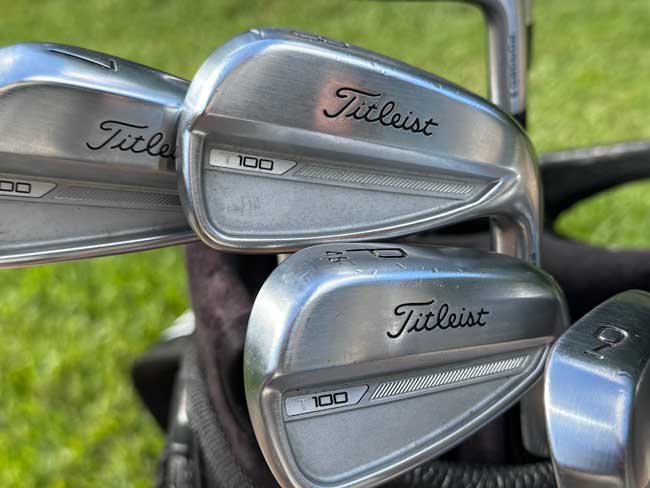
The T100 demonstrates more aggressive technology integration:
- Multi-piece forged body with SUP10 face inserts
- High-density tungsten weighting throughout 3-7 irons
- Optimized CG placement for improved launch angles
- Variable bounce geometry without changing visual profile
- Continuous face design for leading edge consistency
The T100 adds one-degree stronger lofts compared to previous versions while maintaining spin and stopping power. This technology layer creates the forgiveness and distance benefits while keeping the compact head shape that better players demand.
Price and Value Considerations
These are not cheap irons. Investment levels differ between these iron sets, reflecting their technology content and market positioning.
- 620 CB: Originally priced around $175 per club in steel ($187.50 graphite) at launch
- T100: A 7-piece set (4-PW) typically retails between $1,400-$1,600 depending on shaft options
The value equation depends on what you prioritize. The 620 CB offers exceptional feel-per-dollar for players who consistently strike the center. The T100’s technology premium makes sense for those who benefit from the forgiveness and maximum distance gains.
Both iron sets support full custom fitting options including shaft selection, lie adjustment, and loft modification. Project X LZ and high-weight steel shafts come standard on the CB, while the T100 offers AMT White and White Tour options. Proper fitting becomes essential with either set—the stronger lofts in the T100 particularly require attention to wedge gapping.
Which Should You Choose?
Choose the CB if:
- You prefer traditional forged feel with maximum feedback
- You consistently strike the center of the face
- You value classic aesthetics with a thinner topline and minimal offset
- You play at a low handicap (0-5) and prioritize shot control
- You want the ability to work the ball in both directions
Choose the T100 if:
- You want more forgiveness without sacrificing a players’ iron profile
- You need improved distance and high launch
- You play at a mid-to-low handicap (0-12) with slightly inconsistent strikes
- You prefer technology integration that reduces mishit penalties
- You’re building a bag that maximizes performance alongside control
For players who can’t decide, consider a combo approach: T100 in the long irons where forgiveness matters most, blending to CB in the shorter irons where feel and control take priority. This creates the best of both worlds for many players.
Either way, professional fitting remains essential. Test both sets under identical conditions with the same shaft and ball to identify which delivers better results for your swing. The specs on paper tell part of the story, but launch monitor data and on-course performance will guide your final decision.
