
Written by Michael VanDerLaan
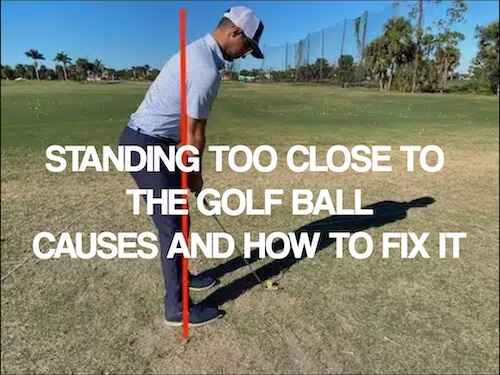
Standing too close to the ball can be caused by many things, including an equipment mismatch, not changing your setup when you change clubs, an inconsistent setup from shot-to-shot, or even an altogether bad setup for your swing identity and body type.
Luckily a lot of these things are easier to fix than a swing problem, and a lot of swing problems are actually rooted in setup problems, so it is always the first place to look. We will look at both the effects and then look at the causes and how to correct them.
Whether you're a relative novice looking to break 90 for the first time, or a more experienced player trying to puzzle it all together, your distance from the ball is an important fundamental.
What Can Happen When You Stand Too Close To The Golf Ball?
Most experienced golf coaches will tell you that they’ve seen almost every way imaginable for a player to try to get the club head on the ball from a bad setup position. That said, there are definitely some tendencies that are more likely than others. Let’s take a look!
Can It Cause A Slice?

In this image, standing too close causes an over the top move. Paired with an open club face, this causes a slice.
Yes, this is one of the most common causes of a slice. From this position, it is more difficult to swing in-to-out and feel like you are hitting the “inside” of the ball. The effect is a very steep swing plane, making it difficult to create speed. All else being equal, when there is no space to swing from the inside, the only place for the club head to come into the ball is by cutting across it. Without another compensation, this can make a player hit the ball all over the yard, with their most common miss being a slice.
Note: oftentimes, an over the top move is made worse by tight grip pressure. Holding the club with the proper amount of pressure will help you fix your slice almost as much as moving farther from the ball!
Does It Cause A Shank?

If you are shanking the ball, the first thing you should look at is your distance to the ball. It makes a lot of sense intuitively is that the closer you stand, the closer the hosel is to the ball, and the more likely it will be for that hosel to creep out towards the ball when swinging at speed.
Another cause of the shank is when the player loses their spine angle, which pushes their hips towards the ball and the result is the dreaded shank.
Can It Cause A Hook?

Standing too close to the ball can cause you to lose your posture and hook it, as shown here.
If you are hooking the ball, this is where the analysis can start to be fun - at least for your golf coach, but maybe not for the golfer! Yes, it can definitely cause a hook, but the reasons aren’t always obvious.
One way or another the player is trying to make a compensation motion to re-route the club to not swing across the ball from the club head being too far outside. The most common things a player will do as a reaction are to start to stand up out of their posture, or early extend in the downswing and stop rotating their body through the shot, causing the club to come from the inside. This is what they are sensing they need, but also the club head starts to rapidly pass the hands through impact while closing down simultaneously.
Talk about a textbook recipe for a hook.
This body movement often causes you to top the ball as well, given the need to reach for the ball as you stand up.
RELATED: Golf Shot Shapes: How To Hit Fades And Draws
Can It Cause A Pull?

In this demonstration, the club is moving from outside to in with a club face that matches the path, causing a pull
We mentioned earlier how setting up too close to the ball can cause a slice or a hook, and this exact same swing path can also result in the dreaded pull hook. This shot is difficult not only because it is off-line, but it will also often go a bit longer than intended, and many golf architects know that “long left” (for a right handed golfer) is a place they want to put a hazard in order to catch these exact shots.
The pattern of swinging across the ball is exactly the same, but a player has managed to close the club face down through impact, resulting in a dead pull instead of a slice.
Can It Cause “Over The Top”?
It is actually easy to come “over the top” when you stand too close, and in order to avoid this, a player will have to make some kind of compensation in their swing as naturally the path of the club will be fighting its way back to an inside route.
One thing players will do is start to manipulate the golf club and pulling down with the hands hard in the downswing in order to not miss the ball entirely and square the face, which gives the classic “over the top'' and “chopping wood” look that many amateurs struggle with.
Try adding a practice station that encourages a better swing plane to your range session to maximize your results.
Can It Cause A “Chicken Wing”?

A chicken wing is often termed one of the most “dreaded” swing faults. While there are a lot of examples of elite players who have a slight bending action in their lead elbow through impact (Jordan Spieth, Victor Hovland), they don’t do so because of the same reasons as most amateurs.
Most amateurs will “chicken wing” because their arms are racing past their body in an arm-driven or stalled-out downswing.
This is a great video of PGA Tour coach George Gankas demonstrating a drill mimicking Ben Hogan getting into a “water skiing” position after impact that will completely avoid any chance of a chicken wing.
If you cannot do this drill without shanking the ball or standing up during the downswing, you are probably standing too close.
Can It Cause Heel Shot?

The heel shot is the most straightforward symptom of standing too close to the ball. Very basically, if no adjustments are made, you are setting your stance in a place where the heel of the club is always going to be trending closer to the golf ball than you want it to be.
On short shots like chipping and putting, it’s possible to stand very close and have it not be an issue, but when you swing hard, the physics and mechanics of the club movement will always have forces pulling the club head away from the body and therefore bringing the heel into play for anyone who is standing too close to the ball.
How Do I Know If I am Standing Too Close To The Ball?

The best way to learn how far to stand from the golf ball is to learn a proper and natural setup position and practice getting into it repeatedly over and over again. This is one of the first things that you will learn in a lesson from a professional instructor. This can vary from player to player but a basic guideline is that when you are in an athletic, balanced golf setup your arms should hang straight down from your shoulders and not be “in your lap.”
After this you should check yourself often - in a mirror or on videotape, and also practice with a practice station to learn how to repeatedly get to the same place every time when you set up and not accidentally creep closer to the ball from time to time.
One other thing to check is that there should be at least a fist of space between your belt buckle and your hands at setup. This is a bare minimum with a wedge. With other clubs it can and should be even more, and there are a lot of players who are successful who have a lot more space than that.
Driver

The driver is the club that you should naturally be standing the farthest away from the ball with, so it is easy to end up standing too close.
Most players will have their arms hanging straight down from their shoulders and with a driver the lie angle of the club will have the hands slightly farther away from the body, with the butt of the club around 2 “fists” away from the belt buckle as a neutral position.
You might be standing too close if you feel “jammed up” through impact, if you struggle with heel shots, or with slices.
Irons

This image shows how the setup position changes based on the length of the iron you are hitting
The driver and iron swing are slightly different It is easy to stand too close to the golf ball with irons, especially since you are slightly adjusting where you stand with each club.
Let the arms hang straight down from the shoulders while in an athletic position with the knees and waist slightly bent, and the arms fairly straight but with soft elbows (not locked out).
You should make sure you have more than a fist of space between the butt of the golf club and your belt buckle with a mid-iron, or else you might be standing too close.
Also check on video to see if you are backing away or standing up in your downswing to make extra space, in which case the first thing you should check is your distance from the ball.
Putter

The eye line outside the golf ball is a good indicator that you are too close to the golf ball.
The putter is the hardest club to stand too close with, as naturally you are going to play it very close and have a controlled swing so it is very easy for your body motion to override the physics of the club. It’s for this reason you will see the most variety in stances for good putters.
Fortunately, the putter is the easiest club to see and feel where you are striking the ball. If you are consistently striking it too far out of the heel, the first thing to do is check if you are standing too close to the ball.
The general rule of thumb is to get your eyes directly over the golf ball. The easiest way to do this is using a training aid, like the Eyeline Putting Mirror.
Once you have found your sweet spot, you should get your putter length and lie angle adjusted to match this setup, instead of matching your setup to a random putter size and shape.
One thing to keep in mind is that you can match your putting grip style to your distance from the golf ball.

The easiest way to tell if you are set up properly with the putter is to check if your eyes are directly over the golf ball, like this!
Which Is Worse In Golf; Standing Too Close Or Too Far Away From The Ball?

A lot of famous pros and coaches (Harvey Penick, Johnny Miller, and Byron Nelson to name a few) have made comments along the lines of “you can never stand too close to the ball.” Like many one-liners from elite golfers and coaches, that is a qualified response that needs some context.
In reality, standing too close or too far could be equally bad, and it depends on how exactly your body reacts to having too much or too little space between you and the ball. This advice is true for golfers whose natural or learned reaction to standing too close is to create more room and clear their hips out without standing up or backing out of the shot, which can lead to a very reliable rotational golf swing that creates a lot of compression, but most amateurs automatically compensate in ways that make contact very difficult.
There are some very good ways to compensate when you stand close to the ball, although you almost never see amateur golfers pull them off. One of the more unorthodox ways is how Jim Furyk creates space by pulling his trail arm almost behind him in the downswing to compensate for standing extremely close to the ball, but he is limited in the amount of power he can create by doing this.
Another one is Bubba Watson who stands very close to the golf ball, makes no compensations, and famously favors a big cut shot, especially with his driver.

Finally you’ll see some players create a lot of space dynamically by driving their lead hip away from the golf ball at the start of the downswing which creates a very good swing pattern promoting good sequencing, rotation, and shaft lean at impact.
Ultimately if you are too far away from the ball you have less options, but it has to be fairly extreme. There are a lot of golfers who stand very far away from the ball as well. You have to be able to reach the ball without throwing the club head at it or falling towards the ball in your swing.
Conclusion

The best way to setup the correct distance from the ball is to practice your setup position by standing straight up and down, then add slight knee flex into an athletic position. Next, while pointing the club straight out in front of you from the sternum with the arms fully extended but not locked, slowly bend at the waist while the upper body and club move together until the club is naturally soled on the ground.
From there, you can start to memorize the right position with each club, and use alignment sticks to build a practice station marking exactly where to stand until it becomes second nature. With one less variable to worry about, you will give yourself the best chance to become a consistent ball striker.
It’s good to learn a proper setup that leaves a fist or two of space between the belt buckle and the butt of the club, depending on the club, and then check it often either by using a mirror, video feedback, or marking your positions on the ground with tape or alignment sticks and repeatedly getting comfortable with the proper distance from the ball.
Pair this fundamental with the proper golf grip, and you will be well on your way to bringing your handicap to an all time low!
If all else fails, It may be worth getting a lesson from your local PGA Professional.
