
Written by John VanDerLaan
*We may earn revenue from the products available on this site and participate in affiliate programs.
We've tested and reviewed some of the top rated center shafted putters on the market today. Our goal is to help you understand which ones perform the best, and how you can use one to improve your golf game!
Best Overall
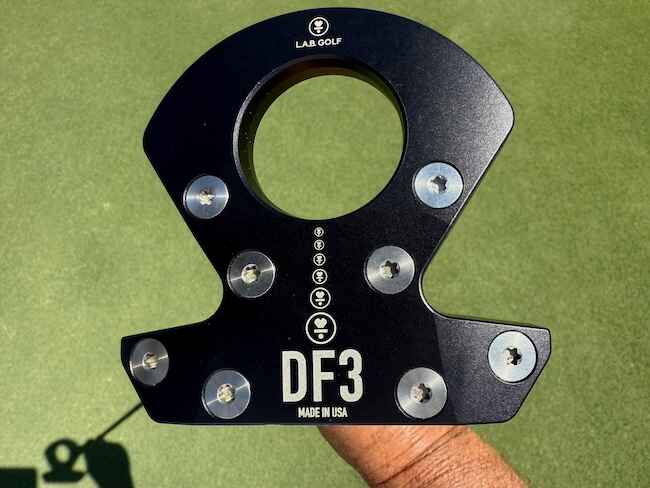
LAB Golf DF3 Zero Torque Putter
Pros:
Cons:
runner up
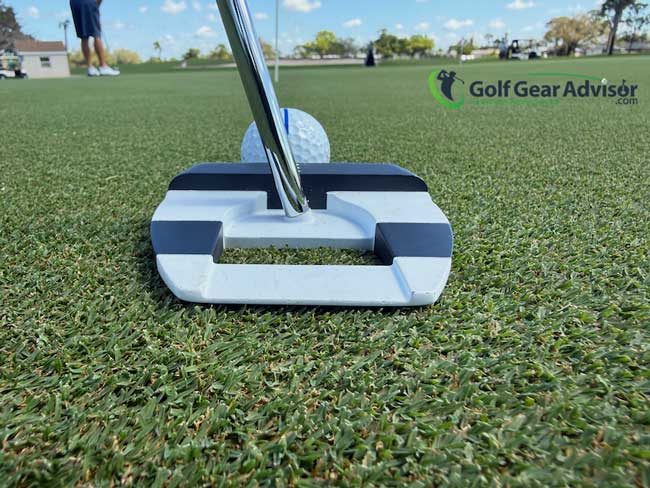
Odyssey Ai-ONE Square 2 Square Jailbird
Pros:
Cons:
Best blade
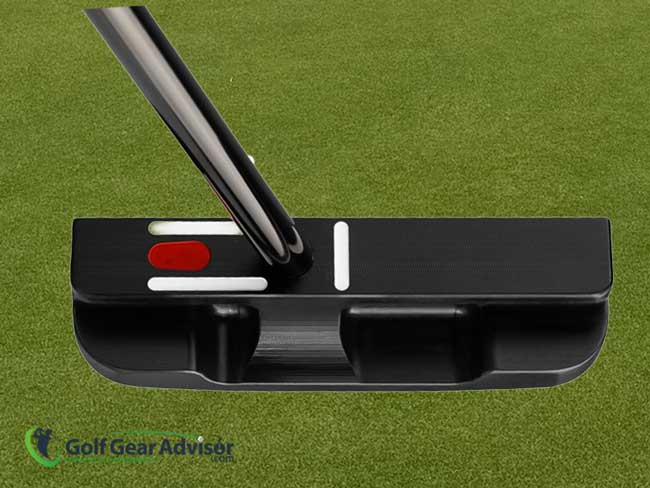
SeeMore Mini Giant FGP Blade Putter
Pros:
Cons:
Center Shaft Putter Reviews
LAB Golf DF3
Best Overall

My experience using the LAB Golf DF3 putter has been nothing short of incredible. The DF3 is now the only putter that I use.
Let me tell you a story:
I received the DF3 putter and took it out on the putting green to try it out. It was a little hard to get used to at first, because of the 3 degree pistol grip, which gave it a built in forward press.
After using it for about a half hour on the practice green, we headed out for 18 holes.
Four hours later, I finished the round with 27 putts and shot 72!
Here is the scorecard from that round.

Needless to say, I was sold on the lie angle balanced technology with this putter.
I have tested the DF3, the Mezz.1 Max and the Directed Force 2.1. While the DF3 performed the best, I was very impressed with the forgiveness of the 2.1, and the Mezz was great on short putts, but had trouble on lag putts.
Specifications:
- Head: Mallet
- Loft: 3 degrees
- Length: 34 inches
- Head Weight: 345-365 grams
Pros
Cons
I told you about my experience with the LAB Golf DF3 above, but the fact is, I am not alone. Many golfers are finding that they can putt like never before when putting the DF3 in their golf bag. It is the best LAB putter that I have ever tested. If you want to make more putts, I recommend The L.A.B Golf DF3 putter.
Click here for my full DF3 review after using the putter for more than 50 rounds.
Odyssey Ai One Square To Square Jailbird
Runner Up
The Odyssey Ai One Square to Square is one of their newest offerings, featuring their no torque design, which promotes a straight back and straight through stroke with a putter face that stays square to the target line. The center shaft option gives a unique look to the ultra-modern design. This putter comes fully loaded from Odyssey with the following features:
- Option of their Stroke Lab counterbalanced shaft for unparalleled stability.
- Industry-leading Ai One face insert for soft feel and smooth roll.
- One of the highest MOI club heads in the industry.
- The center shaft design has a built in forward press.
- Comes standard with the Odyssey Square to Square oversized putter grip.
Specifications:
- Head: Mallet
- Loft: 3 degrees
- Length: 35 inches
- Head Weight: 360 grams
Pros
Cons
The Odyssey Ai One Square to Square was one of my favorite center shafted putters that I tested for this article. The reason it is not higher on the list is because I found the L.A.B. Golf DF3 putter to be much more forgiving. Odyssey also offers the Ai One Square 2 Square in a Double Wide blade design.
Click here to see the results of my testing and my full review of the The Odyssey Ai One Square to Square Jailbird.
Taylormade Spider ZT
Best For Mid Handicappers
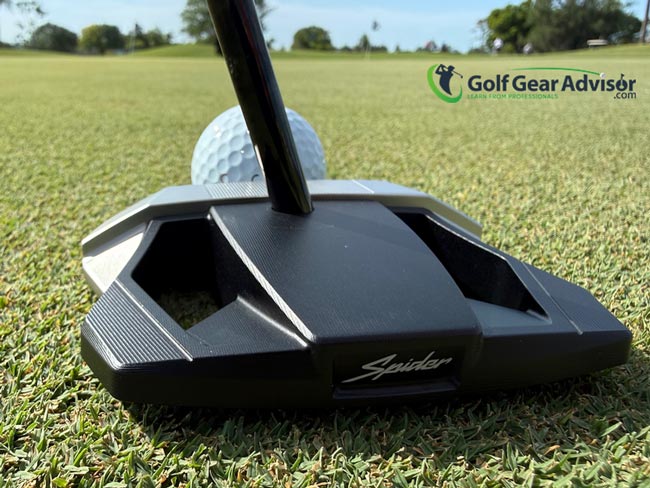
This year's Taylormade Spider Tour line has gotten into the zero torque buzz with the brand new Taylormade Spider ZT, and it is a beauty! I had the chance to try it out over several rounds of golf and I really liked how it performed.
It has a lot of the same zero torque technology as the LAB golf putters, but it is much more aesthetically pleasing and takes less getting used to.
I have always loved the Taylormade Pure Roll insert in my Spider Tour X and I am so glad that they incorporated it into the Spider ZT putter. It gets the ball rolling beautifully, end over end.
The shaft axis sits slightly back and directly over the center of gravity, creating less face rotation and a premium feel.
Specifications:
- Head: Mallet
- Loft: 2.5 degrees
- Length: 33-35 inches
- Head Weight: 370 grams
Pros
Cons
Zero Torque and Lie Angle Balance are transforming putting for amateurs and professionals alike. The Taylormade Spider ZT is the latest to jump into that arena and it is clearly one of the best putters in that category.
Click here to see my full review of the Taylormade Spider ZT putter.
L.A.B Golf Oz.1i
Best Mid Mallet
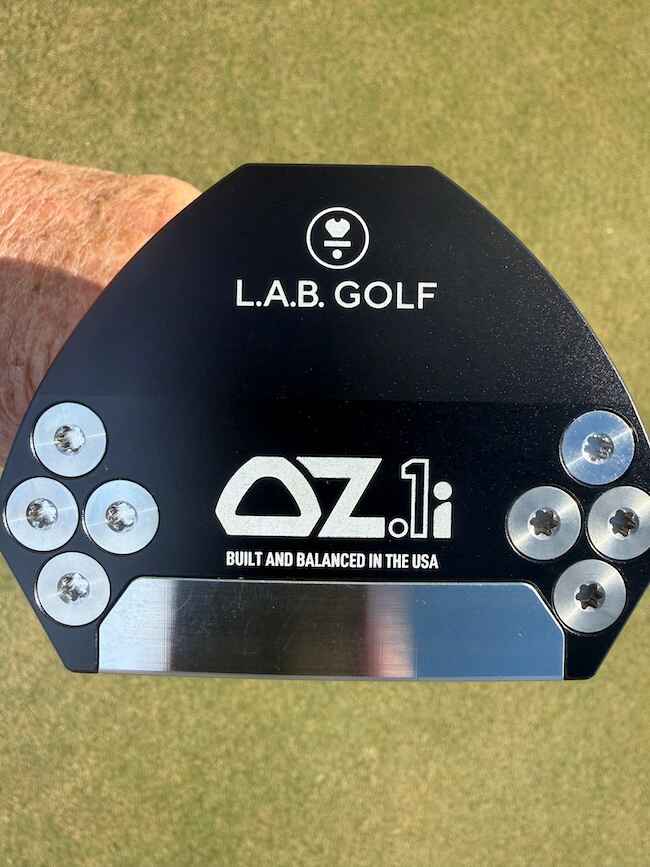
I recently tested both the LAB Oz.1 and the Oz.1i. The only difference between the two is that the Oz.1 is a solid aluminum body mid mallet, while the Oz.1i has a precision milled 303 stainless steel insert.
Both putters performed very well in testing from multiple distances.
You can see the results of my testing here: LAB Oz.1 vs LAB Oz.1i.
The Oz.1 has a softer feel and the Oz.1i has much firmer feel.
Specifications:
- Head: Mid Mallet
- Loft: 2 degrees
- Length: 33-35 inches
- Head Weight: 370-380 grams
Pros
Cons
There is no doubt that the zero torque technology and balancing from L.A.B. golf is the real deal, but some golfers can't stand to look at their large, spaceship designs, so they came out with the Oz putters.
Same great technology, with a more traditional mid mallet design.
Scotty Cameron Phantom 11R OC
Scotty Cameron's Zero Torque
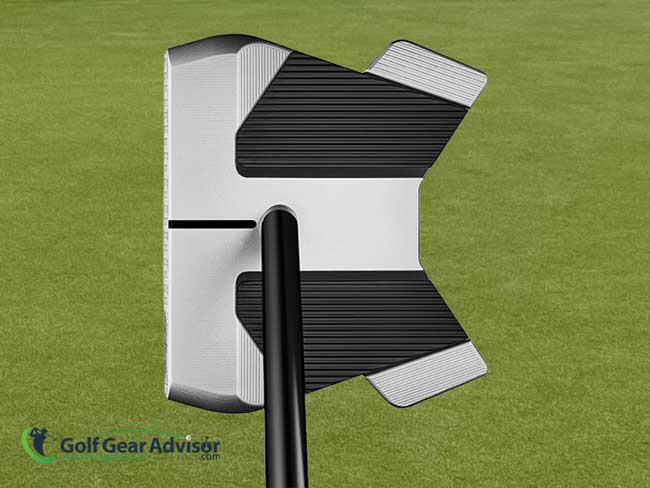
I was very excited to get my hands on Scotty Cameron's version of a zero torque putter, or low torque putter as Scotty calls it.
The OC stands for onset center, which means that it is a center shaft that enters the putter head behind the face, much like the L.A.B. Golf putters.
First impression was that I loved smaller size mallet head and the Matador grip. It is great to look at at address, and given the name, it inspires confidence on the green.
It has a slightly heavier head than other phantom models, for stabilty and speed control.
Specifications:
- Head: Compact mallet
- Loft: 3.5 degrees
- Length: 33-35 inches
- Head Weight: 360-380 grams
Pros
Cons
The Phantom 11R OC is best for players with a straight back and straight through putting stroke. It would be very difficult for a player with an arcing stroke, that prefers to use the putters toe hang, to adjust to this putter.
Click here for my full review of the Scotty Cameron Phantom 11R OC putter.
Scotty Cameron Phantom 5s
Best For Low Handicappers
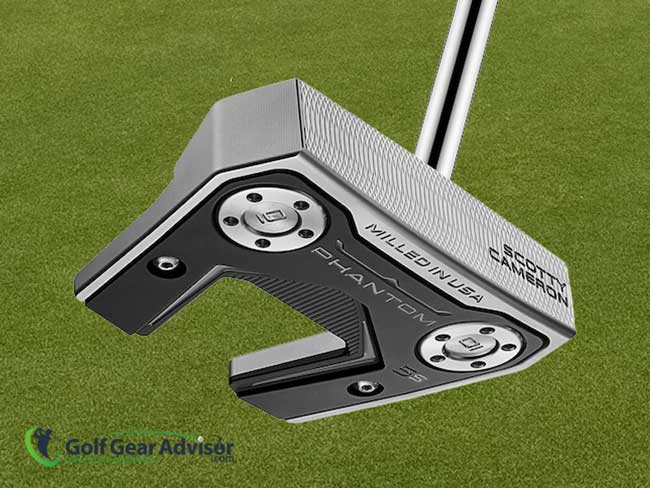
I always look forward to testing and reviewing Scotty Cameron putters and the Phantom 5s did not disappoint. Our staff member and PGA Tour player, John VanDerLaan is sponsored by Titleist and always plays a Scotty Cameron putter. This gives us the opportunity to test and review new models as soon as they are released.
While I love the look and feel of the Phantom 5s, it is not as forgiving as the LAB DF3. It is much better suited to low handicap players and professionals.
Specifications:
- Head: Compact mallet
- Loft: 3.5 degrees
- Length: 33-35 inches
- Head Weight: 345-365 grams
Pros
Cons
The cutting edge design and legendary craftsmanship puts Scotty Cameron putters in a different category than most. The only downside is that they are expensive. That said, they are the best choice for low handicappers and professional golfers, as evidenced by the number of players on the PGA Tour that are playing with Scotty putters every week.
SeeMore Mini Giant FGP Putter
Best Blade
SeeMore is a company that specializes in center shafted putters. They offer more options than any other company. Part of this is because it pairs so well with their signature RST “Rifle Scope Technology” alignment aid, where the shaft of the club “hides” precision markings on the club head when the putter is properly set square at the intended address position. This leads to consistent setup and alignment which is one of the keys to being a great putter.
This is the best SeeMore we tested, and we tested all of the models.
Specifications:
- Head: Blade
- Loft: 2.5 degrees
- Length: 30-39 inches
- Head Weight: 350 grams
Pros
Cons
While not zero torque, the Mini Giant FGP putter is face balanced at impact, meaning it naturally returns to square at impact, with less manipulation required during the stroke to keep the putter face on the correct path. It is a completely neutral and comfortable head shape that allows plenty of familiarity and versatility despite the center shafting and RST technology.
Cleveland HB Soft 2
Best For High Handicappers And Beginners
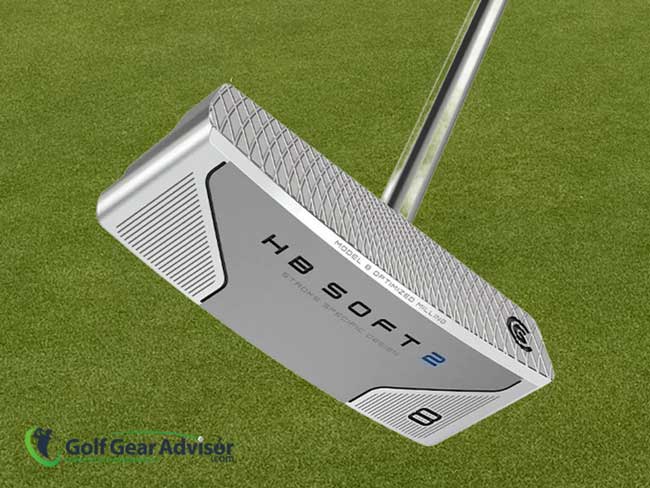
The Cleveland Huntington Beach putters are designed for players of all skill levels, but their lower price point makes them ideal for those that are new to the game and don't want to spend a fortune on a putter.
I found this putter to perform well during testing. I really liked the aggressive, dual milled face texture for grabbing and rolling the ball end over end.
I found it very easy to start the ball on line and I had good distance control, even on off center strikes.
Specifications:
- Head: Blade
- Loft: 3 degrees
- Length: 34-35 inches
- Head Weight: 365 grams
Pros
Cons
Cleveland HB putters distinguishes themselves by face milling its putters in a special way. Instead of having one uniform pattern milled across the face, they double mill the face in a unique pattern, resulting in a slightly more consistent roll.
What Is A Center Shafted Putter?

A center shafted putter is a putter where the shaft attaches either dead-center in the middle of the club head or very near to it. This typically creates what we know as a face-balanced putter head.
The second feature is also that USUALLY the putter contains zero offset - with the shaft attaching straight-in to the putter head with no bends or angles. There are some exceptions to this, like the L.A.B. Golf putters.
RELATED: Putting Grip Styles - How To Grip A Putter
Who Should Use A Center Shafted Putter?

Believe it or not, professional golfers first started using center shaft putters over a century ago culminating in Walter J. Travis winning the 1904 British Amateur using a center-shafted mallet-head putter invented by an engineer who worked for the General Electric corporation in Schenectady, NY. The “Schenectady” putter’s success eventually led to its design being banned by the R&A until the 1950s.
All of this drama aside, the USGA always maintained a different interpretation of the rules, and eventually (after nearly 50 years!) there was a conclusion reached that there was no inherent advantage to the design, and golfers were allowed to use them freely all over the world once again.
As with most putter designs, a lot of players land on a particular choice through trial-and-error. There are many reasons why golfers have tendencies, whether it has to do with how they set up, how they stroke the club, or how they perceive the line that can lend themselves to “matching up” with a certain style versus another.
Center shaft putters tend to work best for players with a reduced arc putting stroke or more of a straight back, straight through putting stroke, although there are plenty of golfers with an "inside, down the line stroke" that putt extremely well with a this putter design.
Another interesting caveat is that a very significant portion of players who end up preferring a center shaft are lead-eye-dominant players, meaning left-eye dominant for a right-handed player. Because center-shafted putters are typically zero-offset designs, assuming the player has a completely neutral setup, this places the ball more under their lead eye, instead of centered between the eyes, which may help with properly perceiving the line of the putt at address.
If any of these things resonate with you, then a center shafted putter may be the answer to fewer putts per round.
RELATED: Are Expensive Putters Worth It?
Which Putter Head Type Do You Prefer?
Center-shafting come in both blade and mallet varieties. Almost any combination imaginable has been used in the putter world, but there are some tendencies and preferences we see between the two designs when it comes to center-shafting.
Blade

The traditional model of putting throughout the ages has been to use a blade style putter with some amount of toe hang, like a Scotty Cameron Newport or Newport 2. While all putters have to be swung on SOME degree of an arc unless the path is manipulated greatly, these putters favor a noticeable arc in the putting stroke.This is a kind of “matchup” that is very common: toe hang, arc stroke, and a blade putter head.
One characteristic of center shaft designs is that they are very commonly face-balanced by nature, as the shaft attaching in the center of a symmetrical putter head would have to be. That said there are exceptions and there are toe-hang putters that have the shaft in the center of the head. Usually if you look at these putters they will be shafted ever so slightly off center in order to encourage some flow and release in the putter head. Otherwise they would have more weight in the toe than the heel either due to shape or weight inserts.
Mallet
A true center-shafted putter lends itself very easily to mallet designs. One thing to understand is that toe-hang and face balancing is not dictated by the attachment point of the shaft, but by drawing an imaginary line from an extension of the club shaft through the club face. This is the actual point about which the mass of the putter head rotates in motion.
For a typical center-shafted putter with a straight-in hosel, then these two points are exactly the same. If you look at some face balanced putter designs however, you will find that, while the hosel is attached somewhere towards the heel by virtue of a bend in the neck, the “imaginary line” extended from the shaft would more or less bisect the putter head. This is what allows the putter to be face balanced.
In effect, these two designs are achieving similar results with a different aesthetic. Many players prefer to have the hosel and attachment point “out of the way” of the ball and sweet spot, and since all the other clubs in the bag are heel-shafted, it gives uniformity to the look and feel at address. Ultimately both are face balanced designs and once again while all combinations are possible and almost all have examples of being used very successfully, it is a common matchup to have a face-balanced mallet putter where the player stands more directly over the ball and uses a consistent putting stroke that is closer to straight-back, straight-through.
Benefits Of Using A Center Shafted Putter

Easier To Consistently Hit The Sweet Spot
Having the shaft in the center helps golfers locate the strike better in the middle of the putter face, as they are focused solely on the sweet spot of the club.
Better Alignment
Center shafting can also help golfers line up to the sweet spot better, encouraging a more solid strike that starts on the intended target. For many it is simply a matter of visual perception that allows them to locate the center of the strike better.
Better On Off Center Hits
There are also arguments made that off-center hits on these types of putters are closer to the “fulcrum point” resulting in less deflection and better distance control.
Less Torque
Center shafted putters are naturally face balanced, which creates less torque, enhancing the stability of the putter. They are ideal for golfers with a straight back to straight through putting stroke.
Frequently Asked Questions
Are center shafted putters more accurate?
Center shafted putters can be more accurate for some players, and those who do benefit from them swear by them. There are many other putters on the market that by the laws of physics should perform very similarly, with the main difference being the visuals and the psychology of the center-shaft. Some players feel like having the shaft right near the sweet spot makes more sense for reliably returning their stroke to that spot.
One difference that can make these putters feel more accurate, as well, is that they coincidentally almost always have zero offset. This can help some players aim the club more accurately, while other players aim the club more accurately with offset. Having a putter that fits your eye and your stroke is one of the greatest ways to get better at golf without taking lessons.
What does putter offset do?
The definition of offset is that the shaft is “offset” from the face of the club. Basically, the two are not directly in line with each other when looking down at address. Effectively, what this is doing, is placing the shaft and thereby the hands slightly in front of the ball at address, without changing the shaft lean at all. This also has the effect of allowing the putter head a split-second of extra time before it passes the ball or passes the hands in the stroke, which gives the putter head more time to square up by impact. It also tends to encourage players to have the ball more centered between both eyes at a neutral address, although this can vary with setup.
The net results of all of these things are that they change the way the golfer sees the line, aims the club, and matches up their release (or lack thereof) through the stroke.
Why are center shafted putters not more popular?
Center shafted putters are relatively unpopular for a couple of reasons.
First of all, they were banned for nearly 50 years by the R&A in Great Britain. While not banned by the USGA, this still put them on shaky ground and established them as an odd-ball experiment for the tinkerer rather than a mainstream choice in golf. This ban was lifted in the 1950s but still their legacy as a fringe piece of equipment remains.
Another aspect is that it’s no coincidence that it is very common to report that golfers who end up falling in love with center-shafted putters are lead-eye dominant. Only about 30% of right handed golfers are left eye dominant. Obviously this doesn’t exclude other golfers from having success with these putters but it is definitely a trend that the majority of golfers do not fit.
Lastly, for whatever reason, many golfers just think that they look and feel odd. This could be partly because all the other clubs in the bag are heel shafted and hitting it on the shaft is something golfers always try to avoid! Also most golfers grew up with “traditional” putters with either bent hosels, heel attachment points, offset, or all of the above and are creatures of habit.
In addition, while center shafting might make sense on paper, lending to a simpler setup and functionality of the putting stroke and strike point, there might actually be some advantages to a toe that opens and closes in a flowing motion and heel attachment points might actually create a more consistent (one-way) deflection on off-center hits in practice.
What PGA Tour members use a center shafted putter?
Center shafted putters took center stage during the careers of Payne Stewart and Zach Johnson, both of whom have won major championships using these putters. Also, many PGA Tour pros have experimented with center shafted models from time to time but rotated to other putters eventually. Overall, on a normal week less than 10% of the PGA Tour field will use a center shafted model.
Ernie Els has used a center shafted putter lately in his Champions Tour career, and the new model from L.A.B. Golf that Adam Scott uses is an elaborate lie angle balanced design. Padraig Harrington changes equipment a lot but has gamed the Wilson Infinite Southside recently, and Dustin Johnson won the Travelers Championship in 2020 using a TaylorMade Truss.
Final Thoughts
These putters certainly aren’t for everyone - either technically or aesthetically - and while they remain a very “alternative” option on the greens for most golfers, they have a very dedicated following that has proven their staying power in the game.
Many golfers who don’t even realize why they like the putters so much end up finding out that they are lead-eye dominant, after the fact.
Other than that, users of the center shaft versions love the fact that it helps them locate the sweet spot on the putter face both at setup and through impact, and the feeling of striking the ball with the shaft is extremely reliable and repeatable for them.
Another huge subset of golfers are not center shaft devotees, but love tinkering with new putters and setups - both at the amateur level and the professional level, and will keep a center-shafted putter or two in the rotation. Many find the look amusing and others find it to be very quirky and enjoy playing with unique clubs.
At the end of the day, it’s definitely not for everyone, but if you’re struggling with aiming your putts or striking the center of the putter face, try putting one in your golf bag and see if your scores improve!
