
Written by John VanDerLaan
*We may earn revenue from the products available on this site and participate in affiliate programs.

You don’t need a perfect golf swing to break 90. You don’t need to hit towering drives or stick approach shots to three feet. What you need is a simple plan, five reliable shots, and the discipline to avoid blow-up holes that turn promising rounds into frustrating ones.
Breaking 90 means posting an 89 or better on your scorecard—17 over par on a standard par-72 golf course. For most golfers who currently shoot in the mid-90s to low-100s, this milestone is closer than you think. This guide gives you a practical, no-nonsense roadmap to get there, starting with strategies you can use in your next round.
Our experts here at Golf Gear Advisor have tremendous experience playing golf at a high level. 4 NCAA National Championship rings and too many made cuts on tours to count have taught us a lot about getting the ball in the hole. These are our best suggestions to help you understand how to get better at golf without lessons!
What “Breaking 90” Really Means (and Why It’s Closer Than You Think)

Let’s start with the math. On a par-72 course, shooting 90 means averaging bogey on every single hole. Shoot 89—one stroke better—and you’ve officially broken the barrier.
Here’s what scoring in the upper-80s actually looks like:
- 18 bogeys on a par-72 = exactly 90 (5 × 18 = 90 strokes)
- 11 bogeys + 7 doubles = 89 (55 + 42 = 97… wait, let’s recalculate: 11 × 1 over + 7 × 2 over = 11 + 14 = 25 over par = 97)
- Better example: 17 bogeys + 1 par = 89 (17 over + 0 = 17 over par)
- 15 bogeys + 3 pars = 87 (15 over par on par-72)
The key insight: you don’t need birdies. You don’t even need many pars. A round dominated by bogeys with very few “others” (triples, quadruples, or worse) is enough to get you into the 80s.
What handicap does this represent?
- Golfers who regularly break 90 typically carry a handicap index between 15 and 20
- If you currently shoot 95-105, you’re likely in the 18-24 handicap range
- The gap between where you are and breaking 90 is often just 4-8 strokes per round
The reassurance here is simple: if you’ve ever posted a round in the low-to-mid 90s, you’ve already demonstrated the potential to break 90. Under the World Handicap System, your index reflects your best performances, not your average score. Your 93 on a good day proves you can play golf at a break-90 level—you just need to do it more consistently.
The rest of this article gives you an actionable round-by-round plan, five core shots to master, smart course management for every hole type, and a practice routine that won’t consume your life. Let’s get you into the 80s.
How Long It Really Takes to Break 90

Most golfers who currently shoot 95-105 can realistically break 90 within 6-12 months of structured, purposeful practice. This assumes you’re playing 1-2 rounds per week and practicing 2-4 focused hours outside of playing.
Concrete handicap example: A 22-handicap golfer averaging 96-100 strokes can reasonably expect to drop to a 16-18 handicap over a single golf season (spring to autumn). That 4-6 stroke improvement is exactly what separates consistent 90s shooting from occasional 80s rounds.
What speeds up progress:
- Tracking simple stats after each round (fairways, greens, putts, penalties)
- Practicing with purpose—specific drills, specific goals, not mindless ball-beating
- Focusing 50% or more of practice time on putting and short game
- Playing from appropriate tees for your distance
What slows things down:
- Random range sessions with no targets or routine
- Chasing extra driver distance instead of minimizing penalty strokes
- Making swing changes mid-season (save those for the off-season)
- Playing courses that are too long or too penal for your current game
The rate of improvement is individual, but here’s a reasonable benchmark: a focused golfer can expect to see 3-6 shots of improvement in scoring average over 3 months of consistent effort. That might not sound dramatic, but dropping from 98 to 92—or from 94 to 88—is exactly the margin that separates “almost broke 90” from “officially in the 80s.”
The Exact Strategy to Break 90 in Your Very Next Round

Before we dive into technique and practice, here’s a simple, “no swing change” strategy you can deploy in your next 18 holes. No lessons required. No months of practice. Just smarter decisions.
The goal: play stress-free bogey golf.
- Aim for bogeys on every hole
- Accept doubles when they happen
- Avoid “others” at all costs (triple bogeys or worse)
Tactical rules for your round:

Take your medicine. From trees or deep rough, punch out sideways to safety
- Leave the ego in the car. No hero shots. No forced carries over water or bunkers you can’t clear 8 out of 10 times on the range.
- Use your safe tee club. If driver causes trouble, hit 3-wood or hybrid instead.
- Aim at centers, not flags. Middle of fairways. Middle of greens.
- Take your medicine. From trees or deep rough, punch out sideways to safety instead of gambling on miracle escapes.
Basic scoring target for 98-102 shooters:
If you currently shoot around 100, your card probably includes 2-4 holes at triple bogey or worse, plus several doubles. The short-term goal isn’t perfection—it’s damage control:
- Turn two triples into doubles (save 2 strokes)
- Turn two doubles into bogeys (save 2 strokes)
- That’s 4 strokes saved, bringing 100 down to 96
Repeat this process over a few rounds, and you’re knocking on 90’s door.
The “personal par” mindset:
If you’re a 95-100 golfer, start focusing on a different internal target:
- Treat every par-4 as a par-5 in your mind
- Treat every par-5 as a par-6
- Par-3s remain par-3s (or par-4s for very long ones)
This simple mental shift removes pressure. You’re no longer “scrambling for bogey”—you’re “playing for your par.” Psychologically, this changes everything.
The rest of this article breaks down five core shots, course management for par-3s, 4s, and 5s, and a focused practice routine to make this strategy automatic.
The Five Core Shots You Need to Consistently Break 90
You don’t need a full tour arsenal to play golf consistently in the 80s. You need five reliable, repeatable shots you can trust under pressure. That’s it.
The five essentials:
- A reliable tee shot that carries at least 160 yards
- Two favorite approach clubs from inside 150 yards
- A solid pitch from 30-70 yards
- One basic bump-and-run chip around the greens
- A reliable two putt and confident short putts
Each shot should be practiced with the same club(s) every time. Familiarity breeds confidence, and confidence produces good scores. These five shots cover 90% of situations you’ll face on a typical golf course from the correct tees.
A Reliable Tee Shot That Carries at Least 160 Yards

Off the tee box, your only job is to keep the golf ball in play and advance it 160-200 yards. That’s it. Forget distance. Forget impressing other golfers. Just find grass.
Pick ONE primary tee club that you can hit in play at least 7 out of 10 times:
Club Option | Typical Carry | Best For |
|---|---|---|
Driver | 200-220 yards | Confident ball strikers |
3-wood | 180-200 yards | Tighter fairways, more control |
4-hybrid | 170-190 yards | Maximum accuracy |
5-iron | 160-175 yards | Extreme accuracy focus |
For most golfers shooting 95-105, a 3-wood or 4-hybrid is often more accurate than driver and still long enough to break 90. The math supports this: penalty strokes (water, OB, lost balls) carry an expected cost of about 2+ strokes each. Reducing penalties by even one per round can save 2-3 strokes.
Tactical approach:
- Aim at the widest, safest part of the fairway
- Aim away from big trouble (water, O.B., deep woods)
- Accept that shorter but safe tee shots set up easy lay-ups and bogeys
A 180-yard tee shot down the middle beats a 240-yard drive into the trees every single time. The guy who hits it straight wins the round, not the guy who hits it far.
Two Favorite Approach Clubs from Inside 150 Yards
From 150 yards and in, simplify your decisions by leaning on two “money” clubs. For most golfers, this might be:
- 8-iron and pitching wedge, or
- 9-iron and gap wedge
The key is knowing your true average distances, not your best-ever shots. Many golfers believe they “hit a PW 130” because they once did it downhill with wind behind them. In reality, their average on-course carry is probably 110-115.
Know your real numbers:
Club | “Myth” Distance | Realistic Average |
|---|---|---|
7-iron | 165 yards | 145-155 yards |
8-iron | 155 yards | 135-145 yards |
9-iron | 145 yards | 125-135 yards |
PW | 130 yards | 110-120 yards |
Strategic lay-up planning:
Break long holes into distances that leave your favorite clubs. On a 480-yard par-5:
- 200-yard tee shot leaves 280 remaining
- Instead of a risky 210-yard 3-wood over trouble, hit a safe 150-yard shot
- Now you have 130 yards—exactly your 8-iron
Target the middle of the green, not the flag. Pin-hunting transforms many “on green or fringe” misses into bunker shots and short-sided disasters. Center-of-green as your default target reduces risk and increases two putt bogey opportunities.
A Solid Pitch from 30-70 Yards
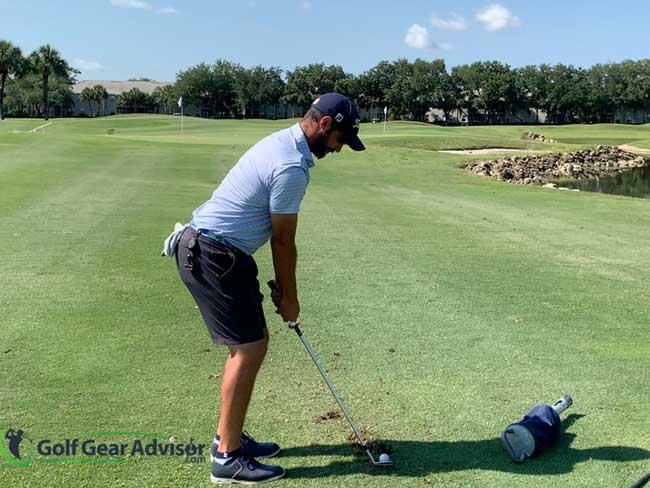
The 30-70 yard pitch is “no-man’s land” for many golfers. It’s too close for a full swing but requires more than a chip. This is where many 90-100 shooters waste strokes with chunks, skulls, and fat shots.
The solution: pick ONE wedge for most pitches.
Your sand wedge (54-56°) or gap wedge (50-52°) works for almost every situation. Using one club standardizes your feel and technique.
Use a simple “clock system” for distance control:
Backswing Position | Sand Wedge Carry | Gap Wedge Carry |
|---|---|---|
9 o’clock (waist high) | 30-40 yards | 40-50 yards |
10:30 (three-quarter) | 50-60 yards | 60-70 yards |
Your exact numbers will vary—calibrate them on the practice area.
Target selection: Aim for the middle of the green, not tight pins. Missing slightly long usually still leaves a two putt bogey. Missing short often produces another awkward pitch, a bunker shot, or worse.
One Basic Bump-and-Run Chip Around the Greens

Choose a single chipping club for most greenside situations. An 8-iron, 9-iron, or PW works well. Learn to get the ball on the ground quickly and let it roll like a putt.
Why the bump-and-run beats the flop shot:
- Smaller swing = less can go wrong
- More margin for error on contact
- Predictable roll behavior
- No need for perfect technique
Low, running chips are more predictable for mid and high handicaps than high flop shots requiring perfect contact. Tour pros get up-and-down 50-70% of the time from basic lies. Mid-handicaps? Often only 20-30%. The difference is largely contact quality and distance control.
Your goal around the greens: Land the ball just onto the green and let it roll toward the hole. Focus on solid contact and direction rather than holing out. The objective is “putting for bogey or par”—get the ball on the green almost every time and give yourself a chance.
A Reliable Two-Putt and Confident Short Putts

Three putts kill rounds. If you typically have 3-4 three putts per round, eliminating just two of them is a straight 2-stroke gain—often the margin between 91 and 89.
From 25-30 feet, your only job is lag putting:
- Leave an uphill second putt inside a 3-foot circle
- Don’t try to make it—try to avoid the disaster
- Speed control matters more than line on long putts
Data shows amateur mid-handicaps three putt from 20-40 feet about 20-30% of the time. Tour players? Under 10%. The difference is almost entirely lag putt distance control.
Short putt routine (inside 5 feet):
- Same set-up every time
- One look at the hole
- Commit and stroke—no second-guessing
Pre-round putting practice: 10-15 minutes before each round, focusing on distance control from 20-30 feet and making 3-5 footers, is more valuable than smashing drivers on the range. This simple habit can save 2-3 putts per round.
While you're practicing, don't be afraid to experiment with putting grip styles to find the one that works best for you.
Smart Course Management for Par 3s, 4s, and 5s
Scoring in the 80s is more strategy than mechanics. The decisions you make on each hole matter more than swing thoughts. Smart course management means playing within your “dispersion pattern”—aiming where your average miss still stays safe.
Think about it: even low-handicaps have significant shot dispersion. A 7-iron might miss 10-15 yards left or right. Mid-handicaps? Often 20+ yards of dispersion. The key is choosing targets where your average miss, whether it is a slice or a hook, doesn’t find penalty hazards, O.B., or deep trouble.
The bogey mindset: Be satisfied with bogey as a good score on tough holes. A simple bogey beats a triple from hero shots gone wrong. Every. Single. Time.
How to Play Par 3s When You’re Trying to Break 90
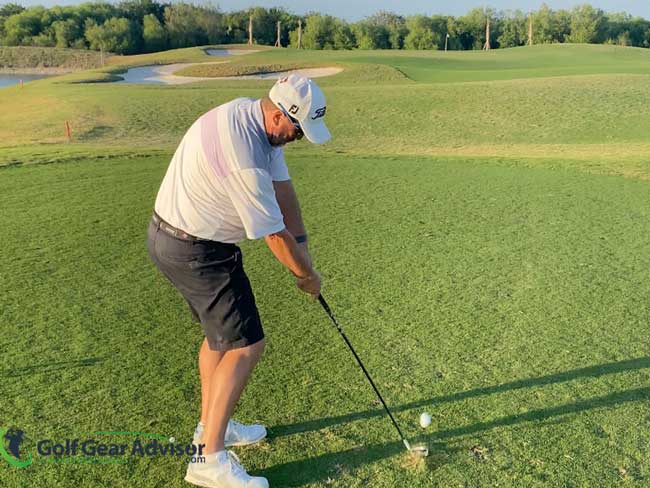
Par-3s are where many amateurs give away strokes unnecessarily. The combination of hitting off turf (no tee), often long distances, and hazards around the green creates problems.
Rules for par-3 success:
- Always take enough club to carry the front of the green comfortably. Many amateurs miss short due to ego—choosing 7-iron for a “150-yard” hole even though their real 7-iron carries 140.
- Aim at the center or fat side of the green. Not tucked pins near bunkers or water.
- If the hole is too long (over 180 yards from your tees), plan to be just short in a safe area and chip on for a simple bogey.
- Treat very long par-3s like short par-4s mentally. Green in two is perfectly fine.
The goal on any par-3 is simple: get on or near the green in one, two putt or chip and putt for bogey at worst. Avoid the water, avoid the bunker shots, avoid the disaster.
How to Play Par 4s to Avoid Big Numbers

Par-4s require different strategies depending on length. Let’s break them into two categories:
Short par-4s (under ~360 yards from your tees):
- Use your safe tee club, not driver
- Aim to leave a comfortable approach shots distance with a favorite wedge or short iron
- Avoid tempting but risky driver plays that bring trouble into play
On a 340-yard par-4 with water at 280, hitting driver is unnecessary risk. A 3-wood to 200 leaves 140—your comfortable 8-iron. Safe tee shot + favorite approach club = routine bogey or par.
Long par-4s (over ~360 yards):
- Plan for three shots to the green: tee shot + lay-up + wedge
- Accept that reaching long par-4s in two shots is unrealistic for your distance
- Be happy with a simple bogey
For many 95-100 shooters, a 420-yard par-4 requires two perfect shots to reach in regulation. Under pressure, that’s rare. Instead, plan 200-yard tee shot + 150-yard lay-up + 70-yard pitch. That’s three manageable shots and a realistic bogey.
Always play away from trouble. Choose lines that give you the widest landing zones, even if they’re not straight at the flag.
How to Turn Par 5s into Scoring Opportunities

Par-5s are normally your best chance to get back shots, but only if you avoid penalties and disasters. Data shows mid-handicaps who try to reach par-5s in two rarely succeed and often find hazards, yielding doubles and triples instead of the birdies they imagined.
The 3-shot plan (default strategy):
- Tee shot: Safe tee club to the wide area, mindful of hazards
- Second shot: Lay-up to your favorite wedge distance (90-110 yards), not as far as possible
- Third shot: Wedge onto green, two putt for par or bogey
Only consider going for the green in two when:
- You’re inside a comfortable distance (not a “career shot”)
- No hazards between ball and green
- Wide landing area with room for misses
A two putt par or even bogey on most par-5s is a huge win toward breaking 90. Meanwhile, other golfers gambling for the green in two are making 7s and 8s. Let them. Bogey golf wins.
How to Practice to Break 90 (Without Living at the Range)
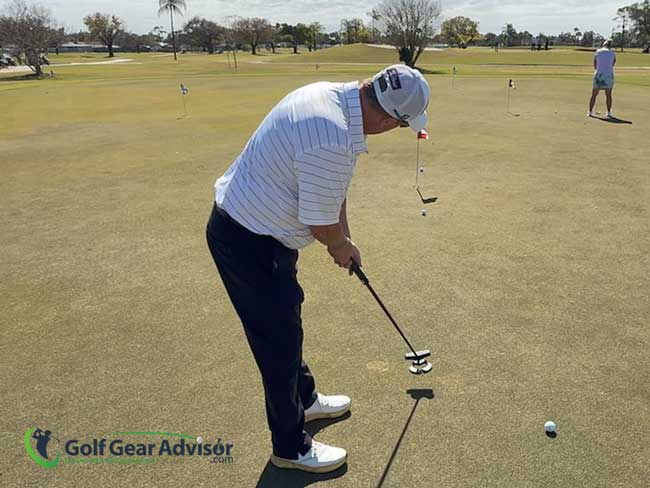
You can break 90 with 2-4 focused hours of practice per week if you prioritize the right skills. The key word is “focused”—quality beats quantity every time.
Recommended practice split:
Skill Area | Time Allocation | Why |
|---|---|---|
Putting and short game | ~50% | Half your strokes come from 50 yards and in |
Wedges and approach shots | ~30% | These set up scoring opportunities |
Tee shots | ~20% | Important but over-practiced by most |
Simple weekly template:
- One range session (45-60 minutes)
- One short-game session (45-60 minutes)
- Pre-round putting whenever you play (10-20 minutes)
That’s 2-3 hours total, plus warm-up time before rounds. Manageable for anyone with a job and family.
Driving Range Session: Tee Shots and Approach Clubs

Practice only the clubs that matter most for breaking 90: your safe tee club, your two favorite approach irons/wedges, and your main pitch wedge. Skip the 3-iron you never use. Skip the 60-degree wedge you can’t control.
“Simulated 9-hole” drill:
For each imaginary hole:
- Hit a tee shot with your primary tee club at a specific target
- Based on outcome (estimate distance/direction), choose an appropriate approach club
- Hit that shot to a new target
- Visualize where ball ends up and “play” the hole mentally
This drill randomizes practice, trains your full pre-shot routine, and builds decision-making skills—not just ball-striking.
Quality over quantity:
- Hit 30-45 balls in 45-60 minutes
- Full pre-shot routine on each swing
- Change targets frequently
Track rough stats:
- % of tee shots that would be “in play”
- % of approaches that would hit or be near green
- For wedges, count golf balls finishing on target green or within 10-yard circle
Short-Game Area: Chipping, Pitching, and Putting

This is where rounds are won and lost. A solid short game turns your best golf into lower scores and rescues your worst days from disaster.
Chipping ladder drill:
- Use your primary chipping club (8-iron or 9-iron)
- Pick 3 landing spots at increasing distances on the practice green
- Hit sets of chips landing at each spot, observing roll behavior
- Objective: control landing spot, not hole-out
Pitching drill:

- Hit 10 balls to a 30-yard target
- Then 10 to a 50-yard target
- Count how many finish on the green or within a 10-foot circle
- Track results over weeks; try to beat personal bests
Putting drills:
Drill | Purpose | How To |
|---|---|---|
Lag putt circle | Distance control | From 20-30 feet, try to finish inside 3-foot circle |
Around the world | Short putt confidence | 6-8 balls around hole at 3-5 feet, make the circle |
Click here for all of our favorite putting drills.
Keep simple notes after each session: “Missed right with chips,” “left 30-footers short,” “solid contact on pitches today.” These observations guide your next practice and create accountability.
Warm-Up and Mental Habits That Protect Your Score
The first 3-4 holes often decide whether you have a realistic shot to break 90. Many amateurs “waste” strokes early due to stiffness, lack of feel, and nerves. A structured warm-up and calm mental approach prevent this.
Simple Long-Game Warm-Up Before You Tee Off

Author Warming Up With An Orange Whip Swing Trainer
Ideal timing: 30-40 minutes before tee time
If rushed, a 10-15 minute version works, but prioritize putting and a few tee shots over full-swing practice.
Warm-up sequence:
- Light stretching (5 minutes): Hamstrings, hip flexors, shoulders, wrists. Dynamic rather than static stretching preserves power and coordination. I like to warm up by using an Orange Whip for a few minutes.
- Hitting sequence (15-20 minutes):
- 5-10 half wedges to groove contact
- 4-6 mid-irons
- 5-8 balls with primary tee club (driver or 3-wood)
- Stop after a good one to lock in confidence
- Putting (10-15 minutes):
- Lag putts from 20-30 feet (speed calibration)
- Short putts from 3-5 feet (confidence building)
The focus is rhythm and contact, not fixing your golf swing or chasing perfect shots. Warm-up is about getting loose and confident, not making swing changes minutes before you play.
On-Course Mindset: How to Think Like a Golfer Who Shoots in the 80s

Good players plan one shot ahead. They choose targets and clubs based on where they want their next shot to be played from, not just where they want this shot to end up.
Mental rules for the round:
- Never add up your score relative to par during the round. Total strokes every 3-6 holes at most, or wait until the clubhouse.
- “Take your medicine” policy: From trees, rough, or trouble, punch out to a safe spot instead of attempting low-percentage hero shots. A punch-out costs one stroke now but saves two strokes from compounding mistakes.
- One shot at a time. The last couple holes don’t matter when you’re standing over this shot. Focus only on the next shot.
Simple stress-relief habit:
Take one deep breath before starting your pre-shot routine on every shot. This consistent ritual keeps tension down and your swing smooth. Combined with a reliable pre-shot routine, it reduces the mental pressure that causes tension-related mishits.
The easiest way to think about on-course mindset: you’re not trying to play your best golf. You’re trying to avoid your worst.
Quick Wins and Gear Choices That Make Breaking 90 Easier
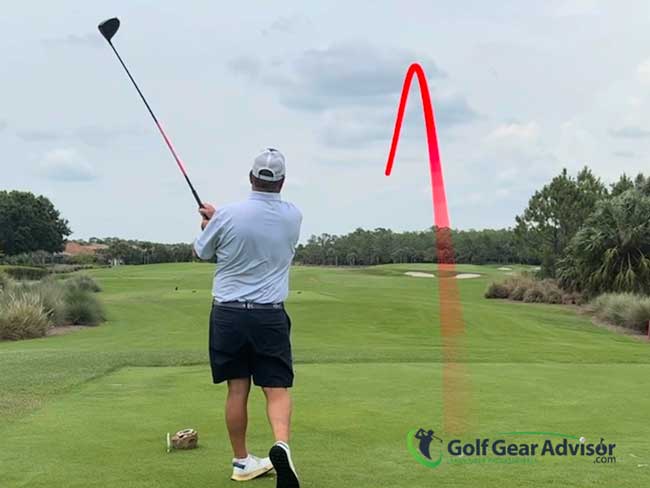
A few practical choices—tees, clubs, and basic tools—can remove unnecessary difficulty from your own game without any practice at all.
Play from the right tees:
Common guidance suggests choosing tees where total course yardage equals your driver carry × 28-30:
Driver Carry | Recommended Course Length |
|---|---|
180 yards | 5,000-5,400 yards |
200 yards | 5,600-6,000 yards |
220 yards | 6,100-6,600 yards |
Many golfers play from tees that make par-4s too long relative to their realistic distance, forcing long irons into greens and increasing triple-bogey chances. Moving up a set of tees shortens second shots, reduces forced carries, and often removes hazards from play entirely.
Use a rangefinder or GPS app:

Knowing exact distances to front/center/back of greens, hazards, and lay-up spots reduces guesswork. Better club selection based on real yardage reduces short misses and hazard balls. Over time, this data also exposes “myth distances” and helps you understand your actual on-course averages.
Here are some rangefinder/GPS recommendations:
- Bushnell Pro X3+ - Bushnell's top of line offerring
- Mileseey GenePro G1 Rangefinder GPS Hybrid - Solid choice combining a laser rangefinder and GPS
- Blue Tees Series 4 Ultra - A budget option for those that want to save some money
Simplify your golf bag:
- One main tee club you trust
- A hybrid or high-lofted fairway wood in place of long irons
- 2-3 wedges with reasonable loft gaps (e.g., 46°-52°-58°)
- A very forgiving putter could save a few strokes per round
- Remove specialty clubs you rarely use or can’t hit consistently
Lessons and fittings:
While custom fitting can produce several strokes of improvement, many players can break 90 first through better strategy and practice, then fine-tune gear later. A basic fitting or even a simple check of lie/loft and shaft flex is beneficial, especially if you’re using very old or inappropriate clubs. But don’t assume new equipment will fix your game—decisions and execution matter more at this stage. It may be worth it to get a lesson or two.
Tracking Progress and Turning One “89” into Your New Normal

The first time you shoot 89-90 is proof of ability. But consistency comes from tracking stats, identifying leaks, and adjusting practice accordingly. I use the Grint App to keep my score and stats
Four simple stats to track for each round:
- Fairways hit (or “tee shots in play” if no defined fairway)
- Greens in regulation or “near-green in regulation” (within 10-15 yards in regulation strokes)
- Number of putts
- Penalty strokes (including O.B., lost balls, water, unplayable drops)
Post-round review:
Look at your scorecard and identify where strokes were lost:
- 4 three putts → focus putting practice on lag and short putts
- 3 penalty strokes → focus tee strategy on keeping ball in play
- Only 2 GIR but many near-greens → focus on wedge proximity
Holes with 7+ scores (on par-4 or par-5) typically indicate blow-up decisions or multiple execution errors. These are your improvement opportunities.
Goal examples for your next 5-10 rounds:
- “No more than 2 penalty shots per round”
- “Three putts on 2 holes or fewer”
- “At least 4 holes per round with near-green in regulation”
Each incremental reduction in penalties and three putts moves your average score closer to the mid-teens handicap that represents a break-90 golfer. You might even consider checking out resources like Golf Sidekick for additional course management videos and effective tips on playing smarter golf.
The repeatable process:
Breaking 90 isn’t a single shot achievement—it’s a repeatable system:
- Safe tee shot that stays in play
- Smart targets aimed at centers, not flags
- Solid short game with consistent contact
- Calm, disciplined mindset under pressure
- Practice and stat-tracking that targets your actual leaks
A golfer who eliminates a couple of penalties and a couple of three putts per round can shave 4-6 strokes, shifting from consistent 95-100 scores into the 89-94 band. That’s breaking 90.
Your action plan starts now.
You don’t need months ago to wish you’d started. You don’t need a new grip or perfect technique. You need the five core shots, a simple strategy for each hole type, and the discipline to avoid disaster.
The next round you play could be the one where you finally crack the 80s. Focus on straight, safe tee shots. Aim at the middle of greens. Lag putt to avoid three putts. Take your medicine from trouble instead of gambling.
Breaking 90 is closer than you think. Go prove it.
