
Written by Michael VanDerLaan
*We may earn revenue from the products available on this site and participate in affiliate programs.
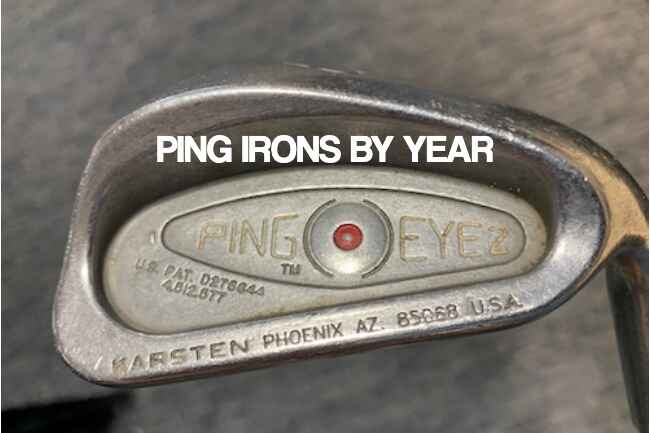
PING represents one of the leading brands in golf, and has been, in many respects, the company that established a lot of the engineering concepts commonly used in modern golf club making. In order to better understand the company that set the stage for so many others, we took a look at all PING irons by year.
The company was founded in the 1960s by Karsten Solheim, a former aerospace engineer turned putter-maker. He challenged almost every aspect of the discipline from materials selection and fabrication techniques to the fundamental shapes and sizes of the components at hand, all the while convinced that he could build superior clubs with his engineering prowess.
After making a name for himself with putters, the company has since successfully made some of the best-selling and longest-appreciated irons and woods of all time. The PING Eye 2 clubs are arguably, the best ping irons of all time, and the PING G series drivers have become irreplaceable on TOUR.
PING has been churning out innovative golf irons for over 50 years now, and has one of the most impressive catalogs on the market. Let’s take a look through time at where they started, how they evolved, and what they have to offer today!
Every Ping Iron Model Listed By Year
The newest game improvement iron from ping is the G440, released last year, and it may be one of the best ping irons ever.
As we take a look at the history of notable PING iron releases, you will notice that they were an early adopter of variations between men's and women's golf clubs.
Ping Irons By Year Chart:
Year released | ping iron model | Latest price/where to buy |
|---|---|---|
2025 | i240 G440 G440 HL | |
2024 | i530 G730 Ping Blueprint S Ping Blueprint T | |
2023 | G430 | |
2022 | i525 | |
2021 | G425 i59 | |
2020 | G710 | |
2019 | G410 Ping Blueprint G Le2 | |
2018 | i500 i210 G700 | |
2017 | i200 G400 | |
2016 | G iBlade | |
2015 | i G Max Ping Karsten | |
2014 | i25 G30 | |
2013 | G25 S55 Anser Forged 2013 | |
2012 | i20 | |
2011 | G20 | |
2010 | G15 i15 Anser Forged 2010 | |
2008 | Ping Rapture V2 | |
2007 | i10 G10 Rhapsody | |
2006 | S58 Rapture | |
2005 | G5 i5 | |
2004 | S59 Tour | |
2003 | S59 G2 G2 HL G2 EZ G2 Ladies i3+ Blade | |
2000 | i3 blade i3 oversize | |
1996 | ISI ISI K ISI BeCu ISI Nickel | |
1994 | Zing 2 Zing 2 BeCu | |
1991 | Zing Zing Becu | |
1990 | Eye 2+ Eye 2 Dot | |
1989 | Eye 2+ No + | |
1986 | Eye 2+ BeCu | |
1985 | Eye 2 Square Groove | |
1984 | Eye 2 EZ Lite | |
1982 | Eye 2 | |
1978 | Eye | |
1969- 1976 | Karsten 1 (K1) Karsten 2 (K2) Karsten 3 (K3) Karsten 4 (K4) |
History Of Ping Iron Models
You can divide Ping iron sets into “eras” where a certain design will continually be tweaked and improved upon, but there are certain transitions that represent a bigger jump in progress. The company’s entire history has been an evolutionary process, but it’s easier to talk about the irons from certain “generations” of club making:
The Early Years (1967-1974)

Karsten Solheim made putters in his garage, and he no doubt toiled over many prototype Ping iron sets in his early years. There is evidence of irons being made as early as 1967, but the most notable widespread release by the company were its “K1” irons released in 1969.
These were followed by K2, K3, and K4 models in subsequent years. These irons already featured early experiments with a lot of the “signature” elements of Karsten’s game-improvement models: an unorthodox, offset, high-toe, cavity back club head that made the traditionalists shudder but were formed on engineering principles that would revolutionize the industry.
If you have ever seen a set of these clubs, they were likely in the back of someone's garage, worn out from years of use covered in rust and cobwebs!
The Ping Eye Years (1974-1999)

Karsten’s first set to completely integrate all of his “game improvement” ideas was the PING Eye. The club featured an oval-shaped cavity back which resembled an eye-shaped opening, and was decorated with a faux “eyeball” and pupil to accentuate the design.
These clubs quickly evolved into the Eye 2, and as they say “the rest was history.” The clubs became the most-sold golf clubs in the history of the game, a mark that may never be broken with the competitiveness and pressure to release new sets in the current marketplace. The Ping Eye 2 Irons were declared to be illegal for play in USGA sanctioned events due to non conforming grooves.
The Eye 2 clubs were used specifically by many champions of the game, including Tiger Woods (as an amateur) and Fred Couples, and due to some rules peculiarities, were in use well into the 2000s by golfers such as Phil Mickelson and John Daly. The PING Zing and PING ISI sets were very reminiscent of the original Eye 2 design featuring just slight tweaks, and also were very popular amongst professionals and amateurs alike.
The “Modern Era” Of PING (2000-present)

By this point in their history, most of PING’s ideas had been copied and the “game improvement” club was a staple of almost every manufacturer's offering. Transitioning into the 2000s saw the beginning of the “Pro V1 Golf Balls Era” on the professional tours, the explosion of Tiger Woods into dominance, and the “distance era” perhaps being born.
PING responded by starting to play with adding multi-metal designs and plastic-capped hollow body inserts with the PING i3, and despite this also becoming the norm from other manufacturers, they started releasing the G-series irons with these inserts. During this time we can also see the beginning of the “loft wars” and these clubs with progressively less loft, bigger clubheads, and bigger cavities became the “super game improvement category.”
With this PING and other companies started to realize that their designs would do best catering to different categories of golfer, and began offering their I-series clubs for those who wanted a little more traditional feel without chasing distance and forgiveness with oversized club heads.
Ping G Series Irons

The PING G series clubs are their all-out game improvement line for golfers looking for a forgiving iron. These clubs spare no measure that could be taken to improve performance, and completely focus on function over form. They are the most forgiving irons that Ping makes. These are comparable to the Taylormade M4 irons, Lazrus irons, or the Titleist T300s.
Ping I Series Irons

Ping I Series clubs are a players distance iron generally designed for the “better player.” While these clubs nowadays incorporate many really great game improvement design aspects, they tend to do so in ways that are less noticeable, or to a less extreme degree than their “G series” “super game improvement” counterparts. A players iron can be compared to the likes of the Mizuno MP-15 or the Titleist CB Irons, for reference.
How Often Does Ping Release New Iron Models
PING is known for not releasing new clubs as often as some other manufacturers. They pride themselves on never releasing clubs just for the sake of increasing sales, but only when they have a legitimate improvement to offer on their old design.
Because of this you see PING using 2-year R&D/production cycles quite often on their iron sets. Some years the clubs are released very near to either side of Jan 1 so the numbers don’t always exactly match up in our table, but you can see this pattern with PING G series irons coming in ‘17, ‘19, ‘21, and ‘23, for example.

FAQs
How can I tell how old my PING irons are?
Finding out how old your PING irons are is super simple. PING does a fairly good job of denoting each model year with unique letter-and-number labels. Just find out the name of your iron set and look it up in one of the above tables to find out its original release year.
What year did the PING G425 come out?
The PING G425 series irons came out in 2021, the same year as the PING G425 series drivers, woods, and hybrids.
Is the Ping G425 a game improvement iron?
Yes, the PING G425 is a great example of one of the best game improvement irons on the market. The club features generously strong lofts, high offset, wide sole, an oversize clubhead design, and an intricate cavity-back to really push the cutting edge of game improvement club design.
Why is there a notch on Ping irons?
The notch on PING irons is no accident, and depending on who you ask, has several benefits.
The primary reason you’ll see cited is that it makes the club easier to bend and adjust for loft and lie, to be fitted to the customer after being manufactured. One hallmark of PING clubs is that they favor cast-iron in their designs more than forged irons. This makes for extremely uniform, consistent, and durable clubs but the clubs are also harder to adjust by bending, as cast iron doesn’t bend as easily as soft forged steel. Hence, this notch makes the clubs more adjustable, if needed.
Also, while potentially small, this notch allows a tiny bit more weight to be redistributed in the head of the club.
Last but not least this notch also allows the club head to pass through rough more easily without snagging.
What Do The Dots On PING Eye 2 Mean?
The dots on the Ping Eye 2 mean the same thing that they do on all other Ping irons. The company has a proprietary fitting system that uses color-codes to fit players into lie angles. The color corresponds to a lie angle measurement, and the intent is for players to use their static fitting chart to choose their clubs in lieu of a formal dynamic fitting.
Final Thoughts
Choosing golf irons can be a challenge. They are an essential for the game of golf that every player must learn to use well. PING is one of the most recognizable names in golf, and their evolution entirely changed the club making game. The company has been able to continue to evolve and survive despite many of founder Karsten Solheim’s innovations being widely copied by competitors.
They first became famous for putters, and their driver-head-covers will be littered throughout the range at any professional event, but in the meantime they also managed to revolutionize and even dominate (for a period) in the iron set market as well.
PING first made irons in the late 1960s, but the big breakthrough came with the success of the Eye series, notably the PING Eye 2, which became the best-selling iron set of all time for the average consumer and won countless championships in the hands of the world’s best. There are still some well maintained Ping Eye 2 sets in play today.
The company has continued to push the envelope and remains an industry leader in innovation as well as durability. Their staying power has been remarkable, lasting well beyond the passing of their founder. The family continues to run the business today, and the only question that remains in the Eyes (pun intended) of PING fans is “what will they come up with next?”
