
Written by John VanDerLaan
*We may earn revenue from the products available on this site and participate in affiliate programs.

The Scotty Cameron Phantom 11R OC represents one of the most interesting putter releases in recent memory. It’s a serious attempt to bring low torque technology to golfers who want stability without sacrificing the premium look and feel that Scotty Cameron is known for. If you’ve been curious about zero torque putters but turned off by their often unconventional aesthetics, this one deserves your attention.
Scotty Cameron Phantom 11R OC: Quick Verdict (Answer First)
Let’s cut straight to it: the Phantom 11R OC lives up to the hype as a genuinely innovative low torque mallet that doesn’t look like it belongs in a laboratory. This putter is built for golfers who want maximum stability and minimal face rotation, but refuse to putt with something that looks wildly unconventional at address.
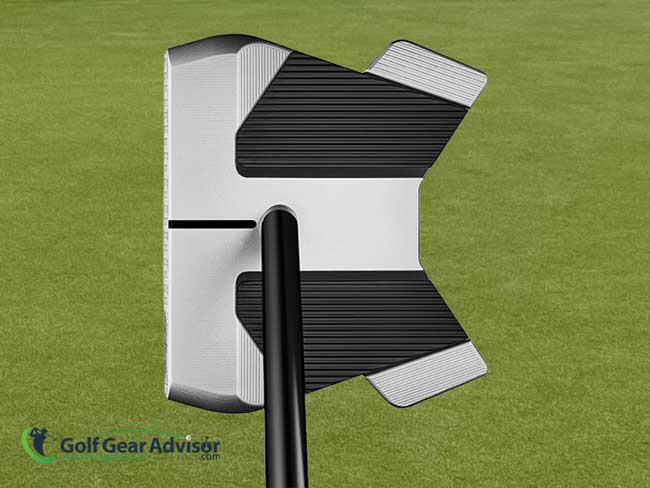
The core technology here is the Onset Center straight shaft design, which positions the shaft directly through the putter head’s center of gravity. Combined with a heavier head (roughly 10-15 grams more than standard Phantom models), chain link face milling across the entire hitting surface, and the signature Matador Mid grip, you get a putter that resists twisting throughout the stroke while maintaining that familiar Scotty feel.
Key Strengths:
- Ultra-stable through impact with near-zero toe flow
- Clean alignment with a single sight line and unimpeded view of the topline
- Soft feel despite the low torque design, thanks to the chain link milling pattern
- Premium build quality and classic Scotty Cameron aesthetics
Potential Drawbacks:
- Premium price point, it is expensive, around £499 / $549
- May feel too “locked in” for golfers with strong arc strokes
- Requires an adjustment period for those transitioning from conventional putters
Best for: Golfers with straight-back-and-through strokes, players who struggle with face rotation under pressure, those wanting low torque benefits without sacrificing visual appeal.
Not ideal for: Players who rely heavily on arc in their putting stroke, golfers who prefer significant toe hang, or those seeking budget-friendly options.
First Impressions & Looks at Address

Pulling the Phantom 11R OC from its premium headcover, the first thing that strikes you is how refined everything feels. The stealthy black shaft contrasts beautifully with the milled steel head, and the overall package screams craftsmanship without being flashy.
The head shape itself is unmistakably Phantom 11, but with softened, rounded edges that create a flowing, confidence-inspiring profile. It’s a compact high-MOI mallet with rear wings that provide stability without appearing bulky. A single alignment line runs cleanly from the leading edge back toward the shaft, offering visual assistance without clutter.
What really sets this putter apart visually is the OC center shaft configuration. The scotty cameron shaft enters the head closer to the face and more centrally positioned, creating that signature “onset” look. This shaft placement gives you a completely unimpeded view of the topline—no awkward shaft lean blocking your sightlines.
Compared to other zero torque putters on the market, like the L.A.B. Golf OZ.1i, PXG Allan putter or the LAB Mezz 1 Max, the Cameron Phantom 11R OC looks remarkably conventional. Those competitors feature considerably more shaft lean, which can create an unorthodox hand position and a distinctly modern appearance. The 11R OC, by contrast, still looks like a classic Scotty—not a lab prototype or science project.
The finish is thoughtfully dark and glare-reducing, with subtle Phantom and Scotty Cameron branding that won’t distract you during your pre-putt routine. There are no busy graphics competing for attention at address—just clean lines and purposeful design.
Tech Overview: What Makes the Phantom 11R OC Different
OC stands for “Onset Center,” and it represents Scotty Cameron’s approach to delivering a low torque, straight-shafted mallet without abandoning the beloved Phantom shaping. This isn’t just a cosmetic update—it’s a fundamental rethinking of how stability and feel can coexist.
The OC straight shaft concept places the custom black shaft closer to the center of gravity and directly over the putter face. This positioning dramatically reduces torque and toe flow, resulting in near-zero toe hang. In practical terms, the face naturally wants to stay square to your path throughout the stroke rather than rotating open and closed.
The heavier head configuration adds roughly 10-15 grams compared to standard Phantom models. This extra mass boosts stability without making the putter feel like you’re swinging a sledgehammer. The weight distribution varies by length:
Length | Weight Configuration |
|---|---|
33” | Two 20-gram weights |
34” | Two 15-gram weights |
35” | Two 10-gram weights |
Understanding the low torque engineering doesn’t require a physics degree. Simply put: less twisting means more resistance to rotation. The putter head stays square to your intended path, reducing the manipulation required from your hands and wrists. For golfers who struggle with overactive hands, this can be transformative.
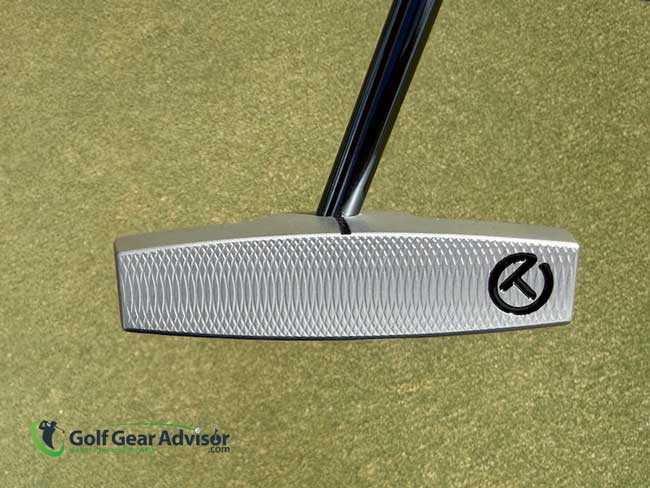
The chain link face milling is a signature element across OC models, and it serves multiple purposes. This full-face milling pattern reduces contact points between the putter face and ball, which softens the sound while maintaining the responsive feedback necessary for distance control.
One subtle but important detail is the 1-degree subtle shaft lean combined with 3.5-degree loft. This creates a tour-style natural hand position with a slight forward press, but keeps the face visually neutral at address. Unlike other low torque putters that force your hands into awkward positions, the Phantom 11R OC promotes a familiar setup that won’t feel alien on day one.
Feel, Sound & Feedback

Rolling the first few putts on a real green with the Phantom 11R OC immediately confirms what the technology promises: this putter tracks like it’s on rails. The ball launches consistently, the sound off the chain link face is satisfyingly muted, and the sensation through the debossed chain link texture of the Matador Mid grip is confidence-inspiring.
The feel can best be described as soft but not mushy, solid rather than clicky. There’s enough feedback to distinguish between heel strikes, toe strikes, and pure centre contact—but it’s muted compared to bare steel milled faces. You won’t get a loud, high-pitched ping that some golfers love; instead, you get a dull “tock” that conveys quality without being intrusive.
On mishits, the sound changes subtly—slightly higher pitched on toe contact, slightly duller on heel strikes. This acoustic feedback helps with self-diagnosis during practice sessions, even though the high MOI design minimizes the performance penalty of off-center hits, making it an ideal putter for high handicap players.
The heavier head and premium black shaft influence feel significantly. Rather than feeling twist or rotation in your hands during the stroke, the putter head moves as one piece with your shoulders. It’s a connected sensation that promotes the rocking motion Scotty Cameron intended—shoulders controlling the stroke, hands staying quiet.
The Matador Mid grip deserves special mention. Its mid-size profile dampens harsh vibrations while promoting lighter grip pressure. The tapered design sits naturally in your hands, and reviewers have noted that it provides immediate feedback when rolling the ball. If you’ve struggled with death-gripping your putter under pressure, this grip encourages a more relaxed hold.
On-course Performance: Stability, Roll & Forgiveness

Staff Member And PGA Tour Player John VanDerLaan Testing The Scotty Cameron OC Putter
Theory is one thing; actual performance on the course is another. During testing rounds with the Phantom 11R OC, several characteristics became immediately apparent.
Short Putts (6-10 feet): This is where the low torque design shines brightest. Under pressure, when hands tend to get twitchy, the face rotation resistance keeps the ball starting on line. Those nervous pushes and pulls that plague many golfers under pressure become noticeably less frequent. The putter wants to stay square, and your job is simply to let it.
Mid-Range Birdie Putts (15-25 feet): The clean alignment and stability translate into confident setups. The single sight line helps match the putter face square to the target, particularly effective when combined with a line on the ball. Start line consistency remains impressive even on slightly off-centre strikes.
Lag Putting (30+ feet): The heavier head helps maintain smooth tempo on longer putts. However, there’s an adjustment period here—some golfers initially leave putts short until they calibrate to the extra mass. Once adjusted, distance control becomes quite consistent, aided by the familiar ball speed that the chain link milling produces.
While not the most forgiving putter available, forgiveness on the Phantom 11R chassis plus OC weighting is substantial. Off-center hits that would cause significant speed loss on smaller blades or compact mid-mallets hold their speed surprisingly well. The high MOI design does its job, reducing the performance gap between perfect strikes and slight mishits.
Key Performance Observations:
- Face feels highly resistant to twisting on off-center contact
- Ball speed remains consistent across the face
- Start line control excellent for straight-back-and-through or very slight arc strokes
- Golfers who typically over-rotate the face may see fewer pulls and pushes
- Players with strongly arced strokes may feel constrained and could miss right
Specs, Options & Fitting Considerations
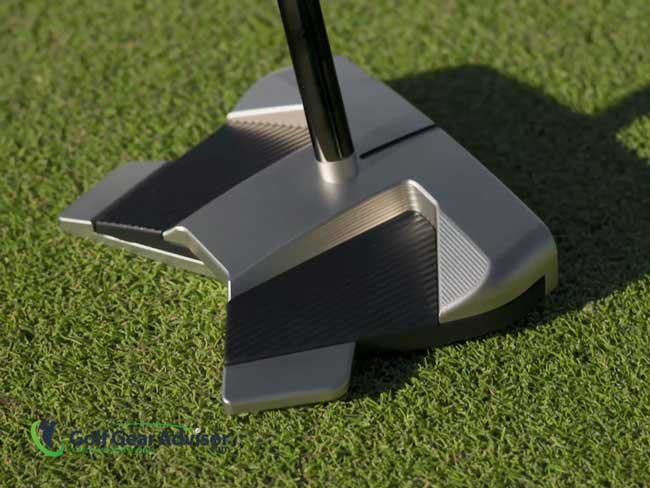
Understanding the full specification picture helps determine whether the Phantom 11R OC fits your game.
The putter retails around £499 in the UK and approximately $549 in the US market, positioning it firmly in the premium segment. Standard specifications include a 3.5-degree loft and 70-degree lie angle, with that characteristic subtle shaft lean of just 1 degree—far less than many competing low torque designs.
Available lengths include 33”, 34”, and 35” as main retail offerings. Both right-handed and left handed option configurations are available, with custom length options possible in half-inch increments for those requiring precise fitting.
The stock grip is the Matador Mid in a dark colour matched to the black shaft. This mid-size, tapered grip is excellent for most golfers, though those with specific grip preferences should note that swapping may affect swing weight and overall balance.
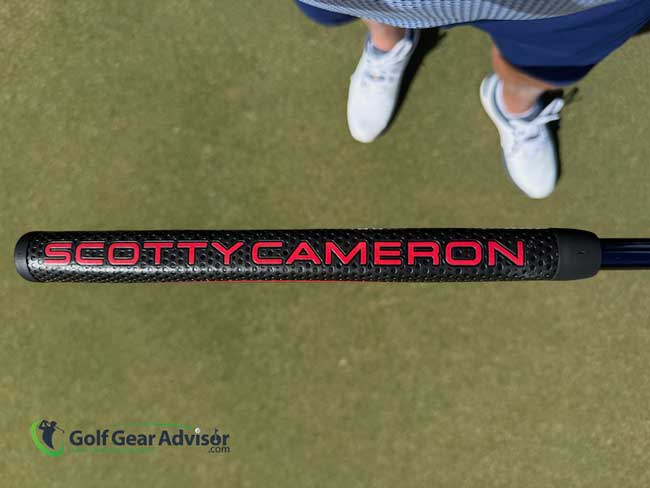
Putter Grip On The Scotty Cameron OC Putter
The 11R designation indicates the rounded corner variant of the Phantom 11 platform. Players familiar with the standard Phantom 11 will find the footprint nearly identical—it’s the same high-MOI chassis with softened edges and that distinctive single topline alignment aid. The “R” simply means round corners rather than the sharper angles of the standard model.
Fitting Recommendations:
- Straight or slight arc stroke: The OC neck is likely your best match
- Strong arc stroke: Consider more toe hang, like a Newport or Newport 2
- Uncertain about stroke type: Get fit on a SAM PuttLab or similar system before purchasing
For those wanting deeper specification comparisons, including options like full shaft offset variants on other OC models (such as the Fastback OC), or counterbalanced options, the official Titleist/Scotty Cameron websites provide comprehensive configuration tools.
Who Should Play the Phantom 11R OC?

The target player for this putter is clearly defined: golfers wanting a high-stability mallet that looks traditional while delivering minimal face rotation. If that description resonates, keep reading. If it doesn’t, this may not be your putter.
Characteristics of Golfers Who Will Benefit Most:
- Straight-back-and-through stroke mechanics
- Tendency to push or pull putts under pressure
- Preference for face-balanced or near-zero toe flow putters
- Comfort with slightly heavier heads (or willingness to adapt)
- Desire for premium aesthetics alongside modern technology
- History of struggling with overactive hands during the stroke
The OC construction specifically eases the transition for players coming from classic Scotty blades or standard Phantom mallets. The alignment feels familiar, the sound and feedback remain in the Scotty family, and the overall experience doesn’t require completely rewiring your putting approach. Tour players like Elvis Smylie have demonstrated this transition, with Smylie winning his first two events immediately after switching to the 11R OC.
Who It May Not Suit:
- Players who rely on strong arc strokes and significant face rotation should consider Newport putters
- Golfers who specifically prefer lots of toe hang
- Golfers that prefer a blade style design, like the Odyssey Ai One Double Wide
- Those who love ultra-loud, clicky auditory feedback at impact
- Budget-conscious golfers seeking value over premium craftsmanship
Before purchasing, seriously consider getting fit or at least comparing the 11R OC to the standard Phantom 11 and other oc models on a putting green. The torque profile and head shape preferences are highly individual—what feels perfectly stable to one golfer may feel restrictive to another.
Phantom 11R OC vs Other Low Torque & Scotty Models
Understanding where the Phantom 11R OC sits in the broader market helps contextualize its value proposition.
Within the Scotty Cameron lineup, the 11R OC occupies a specific niche. It takes the proven Phantom 11 platform—already popular among golfers seeking high MOI stability—and adds the OC straight shaft technology for those wanting even more face rotation resistance.
Phantom 11R OC vs Standard Phantom 11:
Feature | Phantom 11R OC | Standard Phantom 11 |
|---|---|---|
Toe Flow | Near zero | Moderate |
Shaft Position | Onset Center | Offset |
Head Weight | Heavier (+10-15g) | Standard |
Face Feel | Locked-in, stable | More traditional |
Visual Profile | Straight shaft look | Classic angled shaft |
The new models in the OC family include various head shapes, with the 11R OC representing the rounded, high-MOI mallet option. Some OC variants use more compact or alternative head shapes, so the 11R specifically targets players who want maximum forgiveness alongside the torque options.
Compared to non-Scotty low torque competitors like the L.A.B. Golf DF3 and Directed Force 2.1, Odyssey Square To Square or the Spider ZT from TaylorMade, the Phantom 11R OC retains a distinctly more classic appearance. Where competitors often embrace futuristic, technology-forward aesthetics, the Cameron Phantom maintains the heritage look that Scotty collectors and purists appreciate. The chain link milling replaces the ultra-modern face technologies found elsewhere, providing soft feel through traditional craftsmanship rather than space-age materials.
Compared to options from Bettinardi, the Scotty Camerons are far superior.
Clear Positioning: The Phantom 11R OC is the “cleanest looking” low torque mallet for players who want modern performance wrapped in a timeless Scotty Cameron silhouette. It’s golf’s equivalent of a luxury watch with a smart interior—all the technology, none of the ostentation.
Final Verdict: Is the Scotty Cameron Phantom 11R OC Worth It?
The Scotty Cameron Phantom 11R OC successfully blends heritage craftsmanship with innovative low torque technology. It’s milled with precision, finished with attention to detail, and engineered to solve a specific problem that plagues countless golfers: face rotation. The result is a putter that feels premium while performing as a stability-first instrument.
Main Strengths:
- Outstanding stability that resists twisting throughout the putting stroke
- Clean, confidence-inspiring alignment with minimal visual clutter
- Familiar Scotty feel preserved through chain link milling and premium construction
- Aesthetics that don’t scream “technology experiment”
Main Trade-offs:
- Premium price point that demands serious investment
- Heavier head feel requires adjustment for some golfers
- Low torque design best matches straighter strokes; arc players may feel constrained
Buy if:
- Face rotation has been costing you strokes
- You want low torque benefits without unconventional looks
- You appreciate premium craftsmanship and are willing to invest accordingly
- Your stroke is straight-back-and-through or has minimal arc
Think twice if:
- You have a strong arc putting stroke, a Taylormade Spider Tour X or a Cobra 3D Printed Agera would be a better choice
- You prefer lighter head weights
- Budget is a primary concern
- You love significant toe hang in your putter
Zero torque and low torque putters are becoming a serious category on Tour and in retail. As golfers increasingly recognize that face control is the primary determinant of starting line accuracy, demand for stability-focused designs will only grow. The Phantom 11R OC is Scotty Cameron’s most compelling entry into this space—a putter that brings the technology golfers need in a package they’ll actually want to put in their bag.
If you’ve been starting your rounds with missed short putts due to face rotation issues, this putter deserves a serious look and may be worth it for you. Find a course with demo days or visit a fitting studio where you can roll some putts. The feel, the stability, and yes, the gravity of putting with a genuinely premium, technology-forward Scotty might just change your perspective on what a putter can do.
